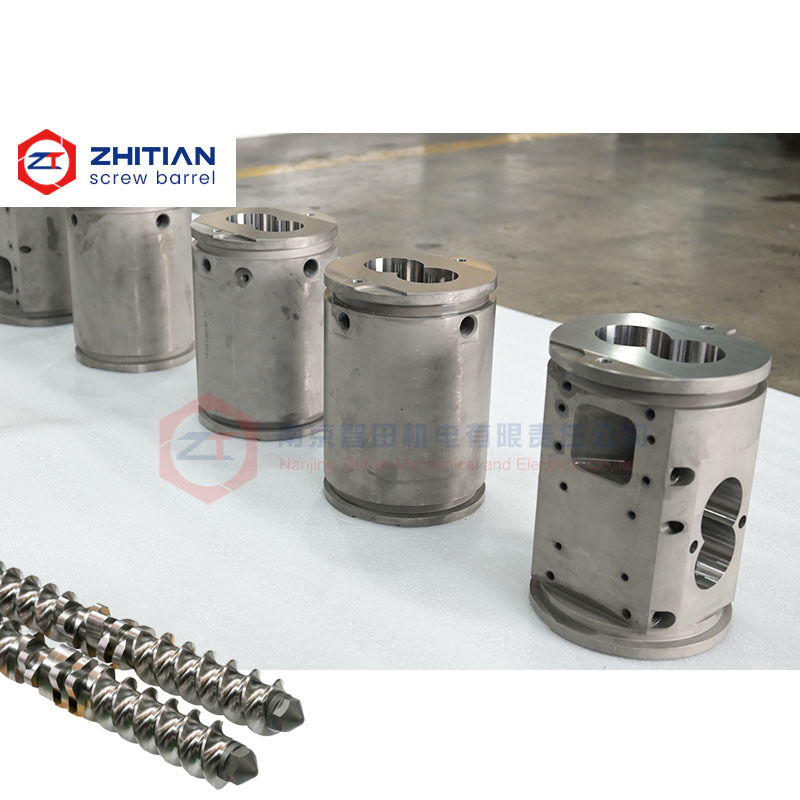
This twin screw extruder barrel for food processing is designed for food, pet food, aquatic feed and premix extrusion applications where cleanability, corrosion resistance and stable replacement dimensions are important.
The barrel can be manufactured with a precision-machined inner bore, customized openings and material options selected according to moisture, salt content, cleaning method and abrasive ingredients.
It helps users reduce common production problems such as:
- Material residue remaining inside the barrel
- Long cleaning time between product changes
- Cross-contamination between different formulations
- Corrosion caused by moisture, salts or food additives
- Bore wear from minerals and hard ingredients
- Incorrect replacement dimensions
- Unplanned downtime caused by damaged barrel sections
Key Specifications
| Item |
Available Configuration |
| Product type |
Twin screw extruder barrel for food and feed processing |
| Main applications |
Food extrusion, pet food, aquatic feed and premix |
| Barrel structure |
Solid, lined or segmented construction |
| Material options |
38CrMoAlA, stainless steel 316L and customized alloy systems |
| Inner-bore finish |
Precision-machined surface, customizable according to application |
| Available sections |
Closed, feeding, venting, vacuum and side-feeding |
| Temperature control |
Customized heating holes and cooling channels |
| Manufacturing basis |
Drawing, used sample or measured dimensions |
| Inspection |
Bore, center distance, interfaces, ports and cooling-channel sealing |
| Main purpose |
Reduce residue, corrosion and cleaning downtime |
Reduce Material Residue Inside the Barrel
Food and feed formulations may contain starch, protein, fat, moisture, salt, minerals and other ingredients that can adhere to rough or damaged surfaces.
Material remaining inside the barrel may create several problems:
- Longer cleaning procedures
- Carryover between batches
- Product color or flavor contamination
- Local degradation during the next production run
- Difficult inspection of the internal surface
- Increased downtime during recipe changes
An easy-clean extruder barrel should have a consistent inner surface without unnecessary recesses, severe machining marks or damaged areas that can retain material.
Inner-bore finish can be controlled according to the selected material and processing requirements. A target roughness should only be specified after confirming the manufacturing route, surface treatment and customer acceptance standard.
Select Materials for Moisture, Salt and Cleaning Conditions
Food extrusion is not automatically a mild operating environment.
Moisture, salts, acids, additives and cleaning agents may gradually attack unsuitable barrel materials. Some recipes also contain minerals or hard particles that create abrasive wear.
Available material approaches include:
Nitrided Alloy Steel
38CrMoAlA with nitriding can be used for general processing conditions where moderate wear resistance is required and corrosion is limited.
It can be a cost-effective option, but it may not be suitable for formulations with strong corrosion, frequent wet cleaning or strict contamination requirements.
Stainless Steel
A stainless steel twin screw barrel may be considered where improved corrosion resistance, easier cleaning or reduced iron contamination is required.
316L is one available option, but suitability must still be evaluated according to the actual recipe, temperature, cleaning medium and abrasive content.
Wear- and Corrosion-Resistant Inner Protection
For recipes containing minerals, bone meal, abrasive additives or corrosive ingredients, optional solutions may include:
- Wear-resistant liner
- Corrosion-resistant alloy liner
- Nickel-based inner-bore protection
- Laser-clad working surface
- Integral alloy sleeve
The most suitable option depends on whether the main failure mechanism is corrosion, abrasion or a combination of both.
Support Different Food and Feed Process Sections
The barrel can be manufactured for different positions along the extrusion line.
Feeding Barrel
Designed to connect with the main feeder or hopper. Opening dimensions can be customized according to the original equipment and ingredient characteristics.
Closed Processing Barrel
Used for conveying, cooking, mixing and pressure development. Material and bore protection can be selected according to the load in that position.
Venting or Vacuum Barrel
Used to remove air, moisture or volatile components. Opening dimensions and vacuum interfaces can be matched to the existing system.
Side-Feeding Barrel
Used when powders, minerals, additives or other ingredients are introduced downstream.
Correct port shape and position help reduce dead areas around the opening and improve compatibility with the existing process layout.
Reduce Cross-Contamination During Product Changes
Manufacturers may process different recipes on the same extrusion line.
Residual material from a previous batch can affect the next product, especially when changing:
- Color
- Flavor
- Protein source
- Allergen-containing formulation
- Medicated or functional feed
- High-fat or high-moisture recipe
The barrel should therefore be considered together with the screw elements, ports, feeders and other product-contact areas.
A smooth and accessible barrel structure can support cleaning, but it cannot by itself guarantee allergen removal or hygienic compliance. The customer’s validated cleaning procedure and applicable regulatory requirements remain essential.
Custom Replacement for Existing Equipment
The barrel can be manufactured according to:
- Original technical drawing
- Used barrel sample
- Measured dimensions
- Existing barrel interfaces
- Process and recipe information
Customizable details include:
- Bore dimensions
- Center distance
- Overall length
- Connection faces
- Positioning dimensions
- Bolt-hole locations
- Feeding and venting openings
- Side-feeder interface
- Heating holes
- Cooling channels
- Temperature sensor holes
- Inner-bore material and finish
When manufacturing from a used sample, worn, corroded or deformed dimensions must be identified and corrected rather than copied directly.
Manufacturing and Inspection
Inspection can include:
- Inner-bore dimensions
- Center distance
- Overall length
- Connection-face accuracy
- Bolt-hole locations
- Port dimensions
- Inner-surface condition
- Cooling-channel sealing
- Material verification
- Alignment with adjacent barrel sections
Inspection records can be retained for future repeat orders and dimensional traceability.
Food-Contact Documentation
Material suitability for food-contact applications depends on the selected alloy, the processed product and the regulations that apply in the customer’s market.
Available documentation should be confirmed before ordering.
Customers should provide:
- Required material grade
- Applicable country or regional standard
- Required material certificate
- Surface-finish requirement
- Product-contact and cleaning conditions
ISO 9001 certification relates to the quality-management system and should not be treated as proof of food-contact compliance for a specific barrel material.
Information Required for Evaluation
Please provide:
- Extruder drawing or used barrel sample
- Barrel position in the extrusion line
- Processed food or feed formulation
- Moisture and salt content
- Abrasive ingredients or mineral content
- Processing temperature
- Cleaning method and cleaning chemicals
- Existing barrel material
- Current wear, corrosion or residue problem
- Required surface finish
- Applicable food-contact documentation requirements
- Required quantity
Frequently Asked Questions
Is stainless steel required for all food extrusion barrels?
No. The material should be selected according to corrosion, abrasion, cleaning and contamination requirements. Nitrided steel may be suitable for some general applications, while stainless steel or an alloy-protected bore may be more appropriate for others.
Can the inner bore be manufactured with a low surface roughness?
Yes. The achievable surface finish depends on the selected material, heat treatment and bore-protection method. The required roughness should be confirmed before manufacturing.
Can this barrel guarantee hygienic or allergen-free production?
No single barrel component can provide that guarantee. Hygienic performance depends on the entire product-contact system, equipment design, cleaning procedure and validation process.
Can a damaged barrel section be replaced individually?
Yes, provided that the adjacent sections, screw elements and interface dimensions remain suitable for continued use.
Request a Food Extrusion Barrel Review
Send us your barrel drawing, processed recipe, cleaning method and current residue or corrosion problem.
We can help evaluate:
- Which barrel material is more appropriate
- Whether a lower inner-bore roughness is required
- Whether corrosion and abrasion are occurring together
- Which barrel sections need upgraded protection
- What dimensional and material documents should be confirmed
Send Your Food Extrusion Barrel Requirements for Technical Review


 Your message must be between 20-3,000 characters!