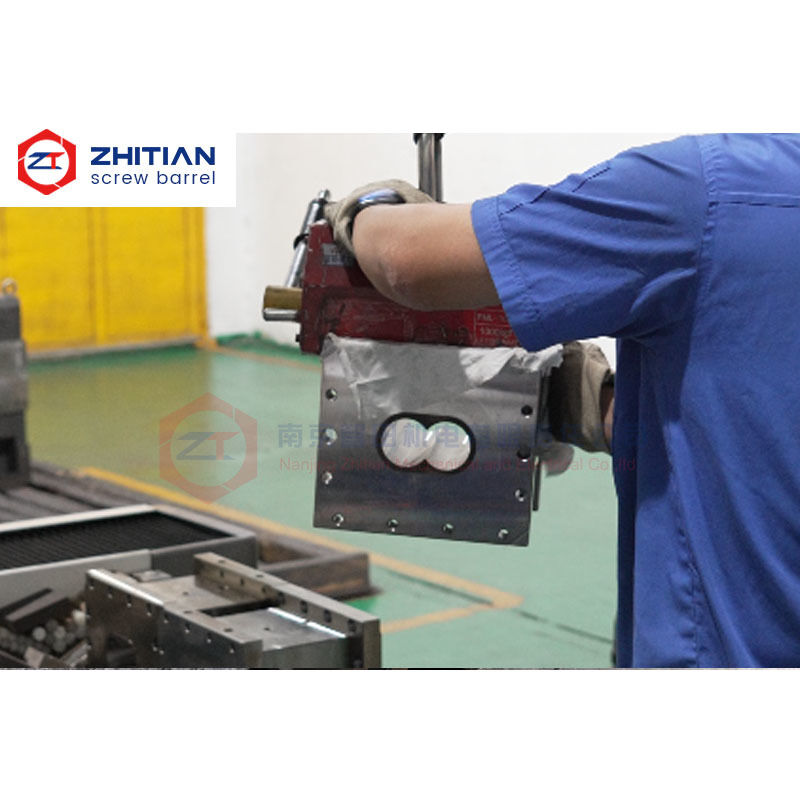
This precision segmented twin screw barrel is designed for extrusion systems where multiple barrel sections must assemble into one continuous and accurately aligned working bore.
In a segmented twin screw extruder, each individual barrel section may meet its own dimensional requirements, but the complete assembly can still develop alignment problems if center distance, bore position, connection faces or locating dimensions are inconsistent between sections.
The objective is therefore not only to manufacture an accurate single barrel, but to maintain consistent geometry across the complete barrel line.
It helps reduce problems such as:
- Bore offset between adjacent barrel sections
- Internal steps at barrel joints
- Uneven screw-to-barrel clearance
- Localized screw or barrel wear
- Material retention at connection areas
- Difficult assembly during replacement
- Pressure or processing instability caused by misalignment
Key Specifications
| Item |
Available Configuration |
| Product type |
Precision segmented twin screw barrel |
| Main purpose |
Maintain bore alignment across multiple sections |
| Barrel types |
Closed, feeding, venting, side-feeding and customized sections |
| Bore structure |
Twin-bore profile according to existing machine geometry |
| Manufacturing basis |
Drawing, sample or measured dimensions |
| Material options |
Nitrided steel, tool steel, alloy-lined and customized materials |
| Temperature control |
Customized heating holes and cooling channels |
| Critical inspection |
Bore, center distance, parallelism, end faces and locating dimensions |
| Replacement type |
Individual section or complete segmented barrel set |
| Main benefit |
Accurate section-to-section assembly and bore continuity |
Why Bore Alignment Matters in a Segmented Barrel
A twin screw extruder barrel is often assembled from many individual sections.
After installation, these sections must form one continuous internal passage for the two screw shafts.
If one barrel section is slightly offset from the next, an internal step may appear at the joint.
This can cause:
- Local material accumulation
- Increased shear at the interface
- Local overheating
- Polymer degradation
- Abnormal barrel wear
- Increased screw-element wear
- Cleaning difficulty
For large or long extrusion systems, dimensional errors can also accumulate across multiple barrel sections.
This makes section-to-section consistency especially important.
Control Center Distance and Bore Geometry
The center distance between the two bores is one of the key dimensions of a twin screw barrel.
If the center distance or bore position is inaccurate, the relationship between the screws and barrel changes.
Possible consequences include uneven operating clearance or localized contact.
Critical dimensions normally include:
- Bore size
- Bore profile
- Center distance
- Bore parallelism
- Barrel length
- Front and rear connection faces
- Locating dimensions
- Bolt-hole positions
These dimensions should be evaluated together rather than individually.
A barrel may have the correct outside dimensions but still produce poor internal alignment if the bore and connection datum are not controlled from the same reference system.
Maintain Bore Continuity Between Sections
For segmented barrels, the connection interface is just as important as the internal bore itself.
When two sections are assembled, their bores should transition smoothly without a noticeable internal mismatch.
Good section-to-section alignment helps maintain:
- More uniform screw clearance
- Smoother material flow
- Lower risk of material retention
- More consistent pressure development
- Better long-term wear behavior
For replacement projects, the new barrel should therefore be checked not only as an independent component but also in relation to the adjacent sections.
Where necessary, existing barrel dimensions and locating features can be measured to confirm the actual assembly condition.
Individual Section Replacement
One advantage of a segmented barrel system is that a worn or damaged section can often be replaced without changing the complete barrel set.
However, the replacement section must match:
- Existing center distance
- Adjacent bore position
- Front and rear connection faces
- Locating structure
- Bolt-hole pattern
- Heating and cooling interfaces
- Process ports
If only a worn sample is available, damaged dimensions should first be identified.
The replacement barrel should restore the intended geometry rather than reproduce wear from the old component.
Material Selection According to the Process
Precision alignment does not mean every barrel must use the same material.
Material can still be selected according to the operating condition.
Typical options include:
- Nitrided steel for general processing
- Tool steel for increased wear resistance
- Alloy-lined structures for severe abrasive conditions
- Corrosion-resistant materials for chemically demanding processes
In a complete segmented system, higher-performance materials can be used only in the sections exposed to the greatest wear or corrosion.
This allows dimensional consistency to be maintained while avoiding unnecessary material cost.
Manufacturing and Inspection
Inspection can include:
- Twin-bore dimensions
- Center distance
- Bore geometry
- Parallelism
- Barrel length
- Connection-face accuracy
- Locating dimensions
- Bolt-hole positions
- Process-port positions
- Heating and cooling channels
- Surface condition
- Material verification
For repeat replacement orders, confirmed dimensional data can be retained to improve consistency between production batches.
Information Required for Replacement Evaluation
Please provide:
- Extruder brand and model information
- Barrel drawing or existing sample
- Bore dimensions
- Center distance
- Barrel section length
- Front and rear interface dimensions
- Locating and bolt-hole information
- Adjacent barrel section data, if available
- Processed material
- Existing wear condition
- Required barrel material
- Required quantity
Photos of the barrel joints and worn areas can also help identify whether the problem is related to normal wear or section misalignment.
Frequently Asked Questions
Why can two accurate barrel sections still become misaligned after assembly?
Because bore accuracy alone is not enough. Connection faces, locating dimensions and center distance must reference the same geometry.
Can only one barrel section be replaced?
Yes, provided the surrounding barrel sections remain serviceable and the replacement section accurately matches the existing interfaces.
Does bore misalignment increase wear?
It can. Uneven clearance or internal steps may increase localized loading and accelerate wear around the connection area.
Should adjacent sections be measured before replacement?
For critical replacement projects, yes. Checking adjacent interfaces helps reduce the risk of copying dimensional errors from a worn barrel.
Request a Segmented Barrel Alignment Review
Send us your barrel drawing, existing section dimensions or sample.
We can help evaluate:
- Whether the bore and center distance match the existing system
- Whether adjacent barrel interfaces require measurement
- Which dimensions are critical for section-to-section alignment
- Whether only one section or multiple sections should be replaced
Send Your Barrel Drawing for Alignment Review


 Your message must be between 20-3,000 characters!