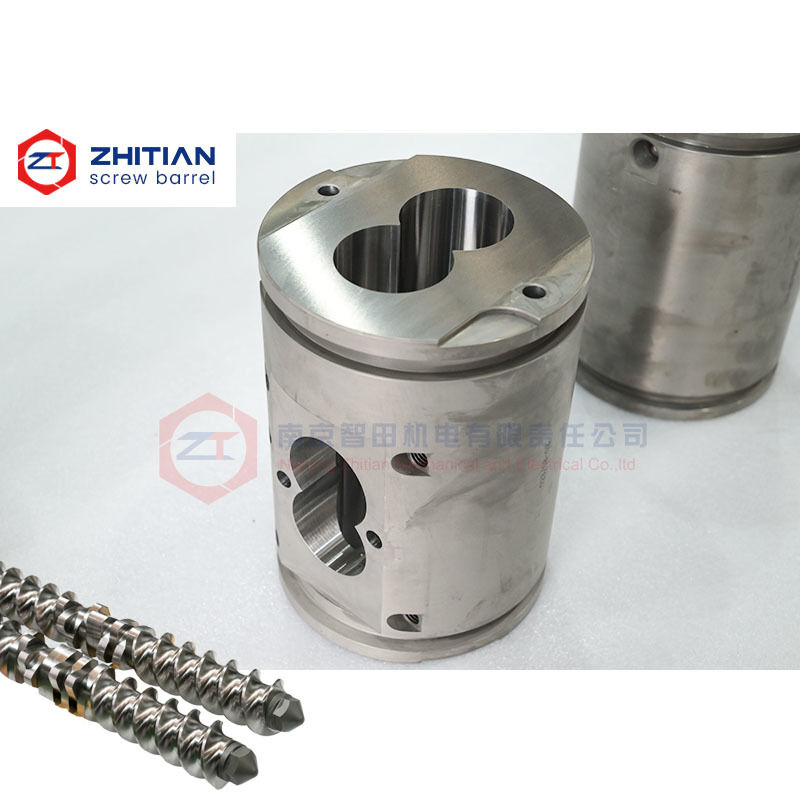
This hygienic twin screw extruder barrel is designed for food, pet food, aquatic feed and premix extrusion applications where inner-bore condition, cleanability and inspection accessibility are important.
The working bore can be precision-machined to achieve a consistent surface condition and reduce deep machining marks, damaged areas and irregular surfaces where processed material may remain.
Barrel material, surface finish, ports and temperature-control features can be customized according to the processed recipe, cleaning method and applicable documentation requirements.
It helps users address problems such as:
- Material remaining in rough or damaged bore areas
- Difficult visual inspection after cleaning
- Long product-change procedures
- Carryover between different recipes
- Corrosion caused by moisture, salts or additives
- Local surface damage that becomes difficult to clean
- Replacement barrels that do not match the existing equipment
Key Specifications
| Item |
Available Configuration |
| Product type |
Hygienic twin screw extruder barrel |
| Main applications |
Food, pet food, aquatic feed and premix extrusion |
| Inner-bore feature |
Precision-machined working surface |
| Surface roughness |
Customizable according to material and acceptance requirements |
| Material options |
38CrMoAlA, stainless steel 316L and customized alloy systems |
| Barrel structure |
Solid, lined or segmented construction |
| Available sections |
Closed, feeding, venting, vacuum and side-feeding |
| Temperature control |
Customized heating holes and cooling channels |
| Manufacturing basis |
Drawing, used sample or measured dimensions |
| Inspection |
Bore dimensions, interfaces, surface condition and channel sealing |
| Main purpose |
Improve bore consistency, cleaning access and inspection control |
Why Inner-Bore Condition Matters
Food and feed formulations may contain starch, protein, fat, salt, moisture, minerals and functional additives.
When the barrel bore contains deep machining marks, corrosion pits, scratches or uneven wear, processed material may remain in these areas after production.
This can lead to:
- Extended cleaning time
- Carryover into the next batch
- Discoloration or flavor transfer
- Local degradation of retained material
- Difficulty confirming whether cleaning is complete
- Increasing surface damage over time
A precision-machined extruder barrel provides a more consistent working surface and reduces unnecessary surface irregularities.
However, the complete hygienic performance of an extrusion line also depends on screw elements, ports, feeders, joints, venting components and the validated cleaning procedure.
Customizable Inner-Bore Surface Finish
The required surface finish should be agreed before manufacturing.
The achievable roughness depends on:
- Barrel material
- Heat-treatment method
- Inner-bore protection
- Liner or cladding structure
- Bore diameter and length
- Final machining and finishing process
- Inspection method
A low roughness extruder barrel bore may help reduce the areas where material can remain, but the lowest numerical roughness is not automatically the best solution for every material system.
For example, a nitrided surface, stainless-steel bore, alloy liner and laser-clad surface may require different finishing methods and acceptance criteria.
The required roughness value and measuring position should therefore be confirmed in the technical specification.
Support More Controlled Cleaning and Inspection
A consistent inner surface makes it easier to identify:
- Remaining product
- Discoloration
- Surface scratches
- Corrosion pits
- Local wear
- Cleaning-agent residue
This is particularly useful when production changes between recipes with different colors, flavors, protein sources or functional ingredients.
The barrel structure can also be reviewed to reduce avoidable retention areas around:
- Feeding openings
- Venting ports
- Side-feeding interfaces
- Sensor holes
- Adjacent barrel connections
The barrel alone cannot guarantee complete removal of allergens, microorganisms or product residue. Cleaning effectiveness must be confirmed through the customer’s complete equipment design, cleaning procedure and validation method.
Material Options for Food Extrusion
Nitrided Alloy Steel
38CrMoAlA with nitriding may be used for general food or feed extrusion where corrosion is limited and moderate wear resistance is required.
It provides an economical solution but may not be suitable for frequent wet cleaning, high salt content or strict contamination-control requirements.
Stainless Steel 316L
A stainless steel food extrusion barrel may be considered where improved corrosion resistance, easier surface maintenance or reduced iron contamination is required.
316L is one available option, but suitability still depends on:
- Processed ingredients
- Moisture and salt content
- Processing temperature
- Cleaning chemicals
- Abrasive filler content
- Applicable documentation requirements
Wear- and Corrosion-Resistant Bore Protection
For formulations containing abrasive minerals, bone meal, hard particles or corrosive ingredients, optional protection can include:
- Wear-resistant liner
- Corrosion-resistant alloy liner
- Nickel-based bore protection
- Laser-clad working surface
- Integral alloy sleeve
Material selection should be based on the actual failure mechanism rather than using the same material for every barrel section.
Maintain Accurate Replacement Dimensions
A barrel with a suitable surface finish must also match the existing extruder correctly.
Important replacement dimensions include:
- Inner-bore geometry
- Center distance
- Overall length
- Connection faces
- Positioning dimensions
- Bolt-hole locations
- Port position and size
- Heating-hole layout
- Cooling-channel interfaces
Incorrect alignment between adjacent sections may create internal steps or gaps where material can accumulate.
Original drawings are preferred. When only a used sample is available, worn, corroded or deformed dimensions must be identified and corrected before manufacturing.
Manufacturing and Quality Inspection
Inspection can include:
- Inner-bore dimensions
- Center distance
- Overall length
- Connection-face accuracy
- Positioning and bolt-hole dimensions
- Port dimensions
- Inner-bore surface condition
- Surface roughness measurement
- Cooling-channel sealing
- Material verification
- Alignment with adjacent barrel sections
The roughness measurement method, measurement position and acceptance value should be confirmed before production.
Inspection records can be retained for traceability and future repeat orders.
Food-Contact Documentation
Food-contact suitability cannot be determined only by the product name or an ISO 9001 quality-management certificate.
The required documentation depends on:
- Selected material grade
- Customer market
- Processed food or feed product
- Product-contact conditions
- Cleaning method
- Applicable national or regional requirements
Customers should specify any required material certificate, declaration or testing documentation before ordering.
Documents can only be supplied when they are available for the selected material and agreed within the order requirements.
Information Required for Evaluation
Please provide:
- Extruder drawing or used barrel sample
- Required barrel section
- Processed food or feed recipe
- Moisture and salt content
- Abrasive ingredients
- Processing temperature
- Cleaning method and cleaning chemicals
- Existing barrel material
- Current residue, corrosion or surface-damage problem
- Required inner-bore roughness
- Roughness inspection method
- Required food-contact documentation
- Required quantity
Frequently Asked Questions
Can the inner bore be manufactured to Ra ≤ 0.8 μm?
It may be achievable for selected material and manufacturing routes. The final requirement must be confirmed according to the material, heat treatment, bore-protection method and measurement standard.
Does a smoother barrel guarantee residue-free production?
No. A consistent surface can support cleaning, but residue control also depends on screw elements, ports, joints, equipment accessibility and the validated cleaning procedure.
Is stainless steel required for all food applications?
No. The correct material depends on corrosion, wear, cleaning, contamination and documentation requirements.
Can the barrel be manufactured from a used sample?
Yes. A used sample can be measured, but worn, corroded or deformed dimensions must be corrected rather than copied directly.
Request an Inner-Bore and Hygienic Design Review
Send us your barrel drawing, processed recipe, cleaning method and required surface-finish standard.
We can help evaluate:
- Which bore material is suitable
- Whether a specified roughness can be achieved
- Which areas may create material-retention risks
- Whether corrosion or wear protection is required
- Which dimensions and documents must be confirmed before production
Send Your Barrel Surface-Finish Requirements for Technical Review


 Your message must be between 20-3,000 characters!