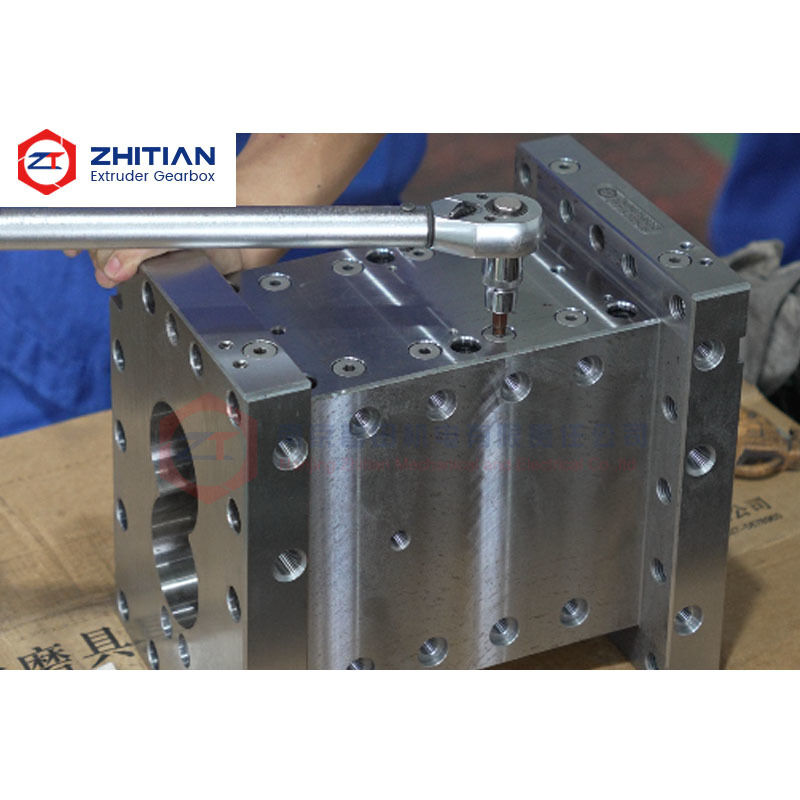
This bimetallic twin screw extruder barrel is designed for compounding applications where high torque, intensive mixing and continuous production accelerate wear inside the barrel bore.
A wear-resistant alloy liner protects the working surface, while the outer barrel body provides structural support and accommodates the heating, cooling and connection features required by the extrusion line.
The design helps users reduce:
-
Rapid bore wear in high-load process zones
-
Increasing screw-to-barrel clearance
-
Output loss caused by material backflow
-
Localized wear around intensive kneading sections
-
Frequent replacement of worn barrel sections
-
Production interruptions caused by premature barrel failure
Key Specifications
| Item |
Available Configuration |
| Product type |
Bimetallic twin screw extruder barrel |
| Main application |
High-load polymer compounding |
| Barrel structure |
Structural body with wear-resistant inner liner |
| Liner options |
Wear-resistant or wear-and-corrosion-resistant alloy systems |
| Available sections |
Closed, feeding, venting, vacuum and side-feeding |
| Manufacturing basis |
Drawing, used sample or measured dimensions |
| Temperature control |
Customized heating holes and cooling channels |
| Customization |
Bore, center distance, ports, interfaces and liner material |
| Inspection |
Bore, center distance, interfaces and liner condition |
| Main purpose |
Reduce bore wear and maintain working clearance |
Why High-Load Compounding Accelerates Barrel Wear
High-torque twin screw extrusion places greater mechanical load on the screw and barrel system.
Intensive kneading, high filler content, elevated throughput and pressure-building can increase the contact and movement of abrasive material close to the barrel bore.
Typical demanding applications may include:
-
Engineering plastic compounding
-
Glass-fiber-reinforced polymers
-
Mineral-filled compounds
-
Functional masterbatch
-
High-filler formulations
-
Intensive dispersive mixing
-
Continuous high-output production
As the inner bore wears, the clearance between the screw elements and barrel increases.
This can lead to material backflow, lower conveying efficiency, unstable pressure and reduced process consistency.
The objective of the bimetallic liner is therefore not simply to increase barrel hardness, but to protect the working bore where wear directly affects extrusion performance.
How the Bimetallic Structure Works
A bimetallic barrel separates two different functions.
The outer barrel body provides:
The inner liner provides the working surface exposed directly to the processed material.
This allows a higher-performance alloy to be concentrated at the bore without manufacturing the complete barrel from the same high-cost material.
Depending on the process, the liner can be selected for:
-
Abrasive wear resistance
-
Combined wear and corrosion resistance
-
High-temperature operation
-
Continuous high-load production
The final material should be selected according to the processed formulation and actual wear mechanism.
Maintain Screw-to-Barrel Clearance
Working clearance is one of the important factors affecting twin screw extrusion performance.
As the bore becomes larger through wear, material can move more easily through the gap between the screw elements and barrel.
Possible symptoms include:
-
Lower output
-
Unstable melt pressure
-
Reduced conveying efficiency
-
Increased material backflow
-
Changes in mixing behavior
-
More frequent adjustment of operating parameters
For this reason, barrel condition should be checked together with screw-element wear.
Installing new screw elements inside a severely worn barrel may not fully restore the expected extrusion performance.
A wear-resistant inner liner helps slow the rate of bore enlargement and maintain the intended working geometry for a longer operating period.
Protect the Highest-Load Barrel Sections
Wear is usually not distributed evenly across the complete extrusion line.
More severe wear may appear near:
-
Intensive kneading sections
-
Glass-fiber feeding positions
-
High-filler mixing zones
-
Pressure-building sections
-
High-temperature processing areas
-
Locations operating under high throughput
It is therefore possible to use different material configurations along the barrel assembly.
Standard materials can remain in lower-load positions, while a twin screw barrel with bimetallic liner is used in sections where wear is more severe.
This allows wear protection to be concentrated where it provides the greatest benefit.
Select the Liner According to the Material
The correct liner depends on what is being processed.
For predominantly abrasive formulations, wear resistance is the main priority.
For formulations where chemical attack occurs together with abrasion, the liner should provide both wear and corrosion resistance.
Important selection information includes:
A liner should not be selected only from a hardness value. Toughness, corrosion behavior and the actual operating environment should also be considered.
Custom Replacement for Existing Extruders
The barrel can be manufactured according to:
Customizable details include:
When manufacturing from a used barrel sample, worn dimensions must be identified and corrected rather than copied directly.
Manufacturing and Inspection
Critical inspection items can include:
-
Inner-bore dimensions
-
Center distance
-
Overall length
-
Connection-face accuracy
-
Positioning dimensions
-
Bolt-hole locations
-
Port dimensions
-
Liner surface condition
-
Cooling-channel sealing
-
Material verification
Dimensional records can be retained to support repeat orders and future replacement.
Information Required for Material Evaluation
Please provide:
-
Extruder drawing or used barrel sample
-
Processed polymer
-
Filler or reinforcement type
-
Filler percentage
-
Processing temperature
-
Screw speed and approximate throughput
-
Existing barrel material
-
Current barrel service life
-
Photographs of the worn bore
-
Position of the most severe wear
-
Expected service-life target
-
Required quantity
Frequently Asked Questions
When should a bimetallic barrel be considered?
It can be considered when standard nitrided barrels wear too quickly in high-load, high-filler or intensive-mixing applications.
Is a bimetallic liner suitable for glass-fiber compounds?
Yes, appropriate wear-resistant liner materials can be selected for glass-fiber-reinforced compounds. The exact solution should depend on fiber content and operating conditions.
Does the complete barrel set need bimetallic liners?
No. Higher-performance liners can be concentrated in the sections exposed to the most severe wear.
Can you manufacture a replacement from a used barrel?
Yes. A used barrel can be measured, but worn or deformed dimensions must be corrected before manufacturing.
Request a Bimetallic Barrel Material Review
Send us your processed material, filler percentage, existing barrel material and photographs of the worn area.
We can help evaluate:
-
Whether a bimetallic liner is suitable
-
Which barrel sections require upgraded wear protection
-
Which liner type is more appropriate
-
Whether screw-to-barrel clearance should also be checked
-
Which dimensions must be confirmed before manufacturing
Send Your Barrel Wear Details for Material Evaluation


 Your message must be between 20-3,000 characters!