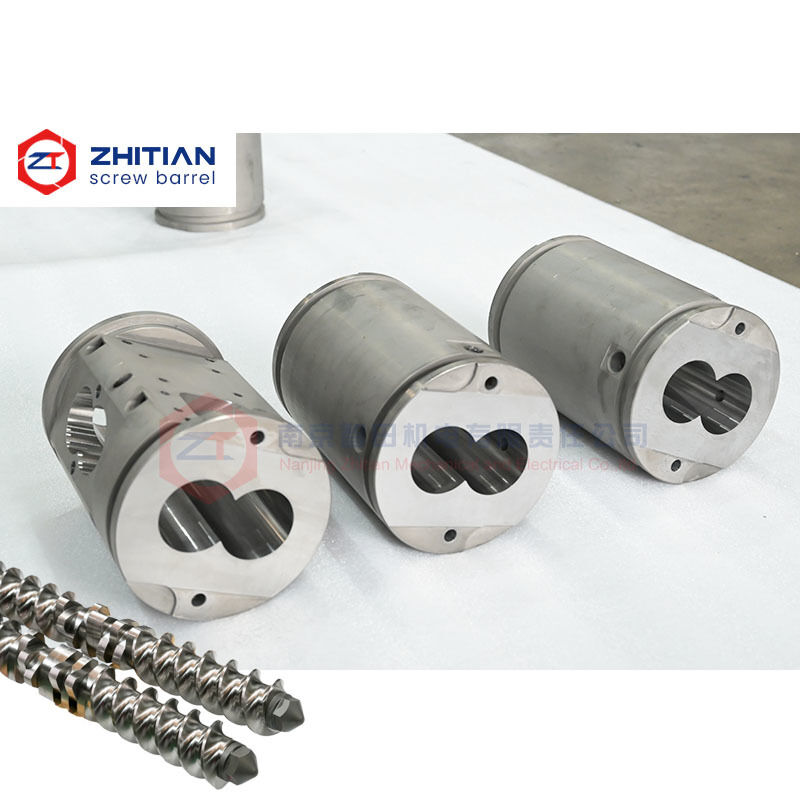
This twin screw extruder barrel for continuous food processing is designed for food, pet food, aquatic feed and premix extrusion lines that operate for extended production cycles.
The barrel can be manufactured with stable bore geometry, customized temperature-control channels and material options selected according to the processed recipe, abrasive content, moisture, salt and expected operating time.
It helps users reduce common continuous-production problems such as:
Gradual loss of output during long operating cycles
Unstable screw-to-barrel clearance caused by bore wear
Melt or product temperature fluctuation
Frequent shutdowns for barrel replacement
Localized wear in mixing and pressure-building zones
Corrosion caused by moisture, salts or additives
Inconsistent replacement dimensions
Key Specifications
| Item |
Available Configuration |
| Product type |
Twin screw extruder barrel for continuous food and feed processing |
| Main applications |
Food extrusion, pet food, aquatic feed and premix |
| Production requirement |
Long operating cycles and continuous processing |
| Barrel structure |
Solid, lined or segmented construction |
| Material options |
38CrMoAlA, stainless steel 316L and customized alloy systems |
| Bore protection |
Nitriding, alloy liner, laser cladding or integral sleeve |
| Inner-bore finish |
Precision-machined and customizable |
| Temperature control |
Segmented heating and cooling configuration |
| Available sections |
Closed, feeding, venting, vacuum and side-feeding |
| Manufacturing basis |
Drawing, used sample or measured dimensions |
| Main purpose |
Maintain stable clearance and reduce production interruptions |
Maintain Stable Clearance During Continuous Operation
The working clearance between the screw elements and barrel bore affects conveying, mixing, pressure development and product consistency.
During continuous operation, bore wear can gradually increase this clearance. As the gap becomes larger, the extrusion line may experience:
Reduced conveying efficiency
Increased material backflow
Lower or unstable output
Pressure fluctuation
Changes in mixing intensity
Longer residence-time variation
More frequent process adjustments
The barrel should therefore maintain accurate bore dimensions and suitable wear resistance throughout the expected operating cycle.
Barrel condition should also be evaluated together with screw-element wear. Replacing only the screw elements may not restore performance if the barrel bore has already enlarged beyond the acceptable range.
Select Materials for the Actual Recipe
Food and feed formulations create different levels of wear and corrosion.
Starch-based products, high-protein recipes, mineral-rich feed, bone meal, salt, moisture and functional additives may place very different demands on the barrel surface.
Nitrided Alloy Steel
38CrMoAlA with nitriding may be suitable for general food and feed formulations with moderate wear and limited corrosion.
It provides a cost-effective option for standard operating conditions.
Stainless Steel 316L
316L stainless steel may be considered where improved corrosion resistance, easier surface maintenance or reduced iron contamination is required.
Its suitability still depends on the recipe, cleaning chemicals, operating temperature and abrasive content.
Upgraded Wear and Corrosion Protection
For more demanding continuous production, optional solutions include:
Tool-steel liner
Bimetallic liner
Nickel-based alloy liner
Laser-clad bore
Integral alloy sleeve
Customized wear- and corrosion-resistant systems
The highest-performance material does not need to be used in every barrel position. Upgraded protection can be concentrated in the sections exposed to the greatest wear or corrosion.
Control Temperature Across Long Production Runs
Continuous food extrusion generates heat from both external heaters and mechanical shear.
If the barrel cannot remove or distribute heat consistently, the process temperature may drift during long operating cycles.
This may affect:
Product expansion
Moisture removal
Cooking level
Texture
Color
Protein structure
Melt pressure
Batch consistency
The barrel can be configured with:
Electric heating holes
Independent cooling-water channels
Segmented temperature zones
Customized inlet and outlet positions
Temperature sensor holes
Interfaces matched to the existing system
Temperature stability also depends on screw speed, throughput, recipe, cooling-water condition and screw configuration. A barrel modification alone cannot correct all process-temperature problems.
Protect High-Wear Process Zones
Wear is rarely uniform across the complete barrel assembly.
Higher loads may occur in:
Main feeding zones
Intensive mixing zones
Side-feeding positions
High-mineral or high-filler sections
Pressure-building zones
Sections exposed to hard ingredients
Different materials can be allocated to different positions.
For example:
Standard nitrided steel in lower-wear conveying zones
Wear-resistant liner in intensive mixing sections
Corrosion-resistant material in moisture- or salt-exposed zones
This targeted approach can help extend replacement intervals without unnecessarily increasing the cost of the complete barrel set.
Support Planned Maintenance and Faster Replacement
Unexpected barrel failure can interrupt production and affect delivery schedules.
For continuous food extrusion lines, it is helpful to monitor:
Bore wear
Screw-to-barrel clearance
Output trend
Melt pressure
Product-temperature stability
Leakage between barrel sections
Condition of high-load process zones
Dimensional records from the existing barrel can also support faster repeat manufacturing.
A replacement barrel can be produced according to:
Original technical drawing
Used barrel sample
Measured dimensions
Existing connection interfaces
Process and material information
When a used sample is supplied, worn, corroded or deformed dimensions must be identified and corrected rather than copied directly.
Custom Manufacturing and Inspection
Customizable details include:
Bore dimensions
Center distance
Overall length
Connection faces
Positioning dimensions
Bolt-hole locations
Feeding and venting ports
Side-feeder interface
Heating holes
Cooling channels
Temperature sensor holes
Inner-bore material and finish
Inspection can include:
Inner-bore dimensions
Center distance
Overall length
Connection-face accuracy
Bolt-hole and positioning dimensions
Port dimensions
Inner-bore surface condition
Cooling-channel sealing
Material verification
Alignment with adjacent barrel sections
Inspection records can be retained for future repeat orders and dimensional traceability.
Food-Contact Documentation
Food-contact suitability depends on the selected material, processed product, contact conditions and regulations that apply in the customer’s market.
ISO 9001 relates to the quality-management system and should not be treated as proof that a specific barrel material complies with food-contact regulations.
Customers should specify:
Required material grade
Applicable country or regional requirements
Required material certificate or declaration
Surface-finish requirement
Cleaning and product-contact conditions
Available documents should be confirmed before ordering.
Information Required for Evaluation
Please provide:
Extruder drawing or used barrel sample
Barrel position in the extrusion line
Processed food or feed recipe
Moisture, salt and mineral content
Abrasive ingredients
Processing temperature
Expected continuous operating time
Existing barrel material
Current wear, corrosion or output problem
Heating and cooling configuration
Required food-contact documentation
Required quantity
Frequently Asked Questions
Which barrel material is suitable for continuous food extrusion?
The appropriate material depends on abrasion, corrosion, cleaning, contamination and expected operating time. Nitrided steel may suit general applications, while stainless steel or alloy-protected structures may be better for more demanding conditions.
Why does output fall during long production runs?
Possible causes include bore wear, screw wear, feeding instability, temperature drift, material buildup or changes in process conditions. The barrel should be evaluated as part of the complete extrusion system.
Can only the high-wear barrel sections use upgraded materials?
Yes. Different materials can be assigned to different process zones according to their actual wear and corrosion conditions.
Can a replacement barrel be produced from a used sample?
Yes. A used sample can be measured, but worn or deformed dimensions must first be identified and corrected.
Request a Continuous-Production Barrel Review
Send us your barrel drawing, processed recipe, operating cycle and current wear or output problem.
We can help evaluate:
Whether bore wear is affecting production stability
Which barrel sections require upgraded materials
Whether heating or cooling channels should be adjusted
Which material is suitable for long production cycles
Which dimensions and documents must be confirmed before manufacturing
Send Your Continuous Food Extrusion Requirements for Technical Review


 Your message must be between 20-3,000 characters!