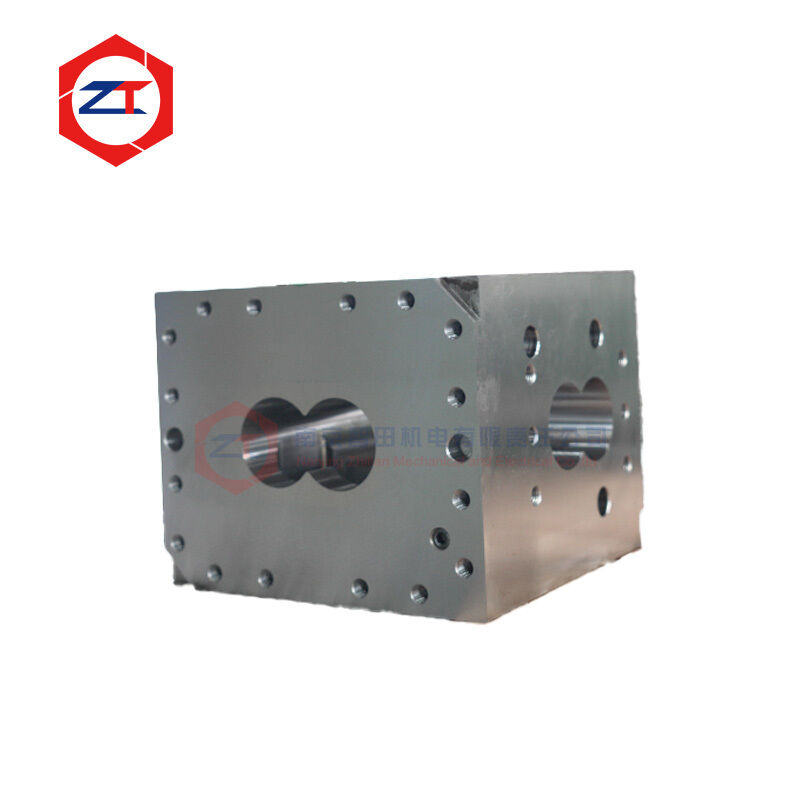
This modular alloy lined twin screw barrel is designed for reactive chemical extrusion processes where corrosion resistance, process-zone control and reliable replacement are all important.
Reactive extrusion often combines polymer processing with chemical reactions inside the extruder. Depending on the formulation, different barrel sections may be exposed to corrosive additives, elevated temperature, volatile components, changing pressure and different residence-time requirements.
A modular barrel configuration allows each process section to be designed according to its specific function, while an alloy-lined working bore provides additional protection in zones exposed to chemical attack or combined wear and corrosion.
It helps address problems such as:
- Corrosion of barrel bores in reactive formulations
- Different material requirements between process zones
- Localized wear or chemical attack
- Difficult replacement of damaged barrel sections
- Insufficient venting or devolatilization capacity
- Inconsistent temperature control through the reaction zone
- Over-specifying the entire barrel set with one expensive material
Key Specifications
| Item |
Available Configuration |
| Product type |
Modular alloy lined twin screw barrel |
| Main application |
Reactive and chemical extrusion |
| Main feature |
Modular process sections with alloy-lined bore protection |
| Barrel types |
Closed, feeding, reaction, venting, side-feeding and customized sections |
| Liner options |
Nickel-based, wear-resistant or application-specific alloy systems |
| Manufacturing basis |
Drawing, sample or measured dimensions |
| Temperature control |
Customized heating and cooling channels |
| Process interfaces |
Feeding, injection, venting, vacuum and side-feeding ports |
| Inspection |
Bore, center distance, interfaces, ports and liner condition |
| Main purpose |
Support reactive processing while protecting critical barrel zones |
Why Reactive Extrusion Requires Different Barrel Zones
Reactive extrusion differs from conventional compounding because chemical or physical changes may occur inside the extruder while the material is being mixed and conveyed.
Different sections of the machine may perform different functions, such as:
- Polymer feeding
- Melting
- Liquid or additive injection
- Reaction
- Intensive mixing
- Venting
- Vacuum devolatilization
- Pressure building
- Final conveying
These zones do not always operate under the same temperature, pressure or chemical environment.
For example, a reaction section may require stronger corrosion resistance, while a downstream pressure-building section may experience more mechanical wear.
Using a modular barrel system makes it possible to configure each section according to its actual process duty.
Alloy Liner Protection for Corrosive Reaction Zones
Some reactive extrusion formulations contain components that can attack conventional barrel materials.
Potential sources of corrosion may include:
- Reactive additives
- Acidic or alkaline components
- Moisture combined with chemical additives
- Halogen-containing formulations
- Reactive intermediates
- Process by-products
If the barrel bore is chemically attacked, pitting and surface damage may gradually change the internal geometry.
This can affect:
- Screw-to-barrel clearance
- Material flow
- Pressure stability
- Cleaning
- Product consistency
- Barrel service life
For these zones, nickel-based or other corrosion-resistant alloy systems can be evaluated according to the actual formulation.
The material should be selected based on chemical environment, temperature and wear condition rather than hardness alone.
Combine Corrosion Protection with Wear Resistance
Reactive extrusion is not always a pure corrosion problem.
Some formulations also contain:
- Mineral fillers
- Glass fiber
- Functional powders
- Pigments
- Reinforcing particles
- Other abrasive additives
In these applications, the barrel may be exposed to both chemical attack and mechanical abrasion.
A material with excellent hardness but insufficient corrosion resistance may still fail prematurely.
Likewise, a corrosion-resistant material with poor wear performance may lose bore geometry under abrasive conditions.
For this reason, liner selection should consider whether the dominant problem is:
- Corrosion
- Abrasion
- Combined wear and corrosion
- Localized damage in one specific zone
Modular Replacement of Individual Barrel Sections
One advantage of a modular barrel system is that damaged or highly exposed sections can be replaced individually.
If corrosion is concentrated in a reaction or injection zone, it may not be necessary to replace the entire barrel set.
Individual replacement can help:
- Reduce maintenance cost
- Shorten spare-part scope
- Concentrate premium materials in critical zones
- Simplify future maintenance
- Preserve barrel sections that remain in acceptable condition
For replacement projects, the new section must match the adjacent barrel interfaces accurately.
Important dimensions include:
- Bore geometry
- Center distance
- Overall length
- Front and rear connection faces
- Positioning dimensions
- Bolt-hole locations
- Heating and cooling interfaces
- Process port positions
Configure Ports for Reactive Processing
Reactive extrusion may require additional process connections beyond standard feeding and venting.
Depending on the process, the barrel can be configured with:
- Liquid injection ports
- Additive feeding ports
- Side-feeder openings
- Atmospheric venting
- Vacuum venting
- Temperature sensor holes
- Pressure measurement ports
- Customized process connections
The position of these ports should match the process sequence.
Incorrect port location may affect reaction time, mixing effectiveness, devolatilization or downstream pressure stability.
Temperature Control Through the Reaction Zone
Temperature control is particularly important in reactive processing.
Some reactions release heat, while other formulations require additional thermal input.
At the same time, excessive temperature can lead to:
- Polymer degradation
- Unwanted side reactions
- Discoloration
- Viscosity changes
- Reduced product consistency
Barrel sections can therefore be configured with customized heating holes and cooling channels according to the thermal requirements of each process zone.
The objective is not simply to heat or cool the barrel, but to support a more stable thermal profile through the complete reaction process.
Accurate Interface Matching for Replacement Projects
A modular barrel section must integrate with the existing extruder.
Replacement manufacturing can be based on:
- Original drawings
- Existing barrel samples
- Measured dimensions
- Machine interface data
- Process requirements
When only a used barrel is available, worn or corroded dimensions should first be identified.
A new replacement barrel should restore the intended geometry rather than copy damage from the old component.
Manufacturing and Inspection
Inspection can include:
- Inner-bore dimensions
- Center distance
- Bore geometry
- Parallelism
- Overall barrel length
- Connection-face accuracy
- Bolt-hole positions
- Process port dimensions
- Heating and cooling channels
- Cooling-channel sealing
- Liner surface condition
- Material verification
For modular replacement, special attention should be given to the connection faces and bore continuity between adjacent sections.
Information Required for Technical Evaluation
Please provide:
- Extruder brand and machine information
- Barrel drawing or sample
- Processed polymer
- Reactive additives or chemical components
- Filler or reinforcement information
- Processing temperature
- Screw speed
- Approximate throughput
- Current barrel material
- Existing corrosion or wear condition
- Location of reaction, injection and venting zones
- Required process ports
- Current barrel service life
- Required quantity
Photos of corrosion, pitting or localized wear can help determine which barrel sections need upgraded protection.
Frequently Asked Questions
Why use a modular barrel for reactive extrusion?
Because different process zones may require different functions, materials, ports and temperature-control arrangements. Modular sections allow each zone to be configured separately.
Does every section need an alloy liner?
No. Higher-performance liner materials can be concentrated in the sections exposed to the most severe corrosion or wear.
Can only one damaged reaction-zone barrel be replaced?
Yes, provided the adjacent sections remain serviceable and the replacement barrel accurately matches the existing interfaces.
Is a nickel-based liner always required for chemical extrusion?
No. The correct material depends on the chemical environment, temperature, abrasion and current failure mode.
Request a Reactive Extrusion Barrel Review
Send us your barrel drawing, reactive formulation and current corrosion or wear condition.
We can help evaluate:
- Which barrel sections require alloy protection
- Whether corrosion or abrasion is the main failure mechanism
- Where reaction, injection and venting ports should be confirmed
- Whether individual barrel sections can be replaced
- Which dimensions must be checked before manufacturing
Send Your Reactive Extrusion Barrel Drawing for Technical Review


 Your message must be between 20-3,000 characters!