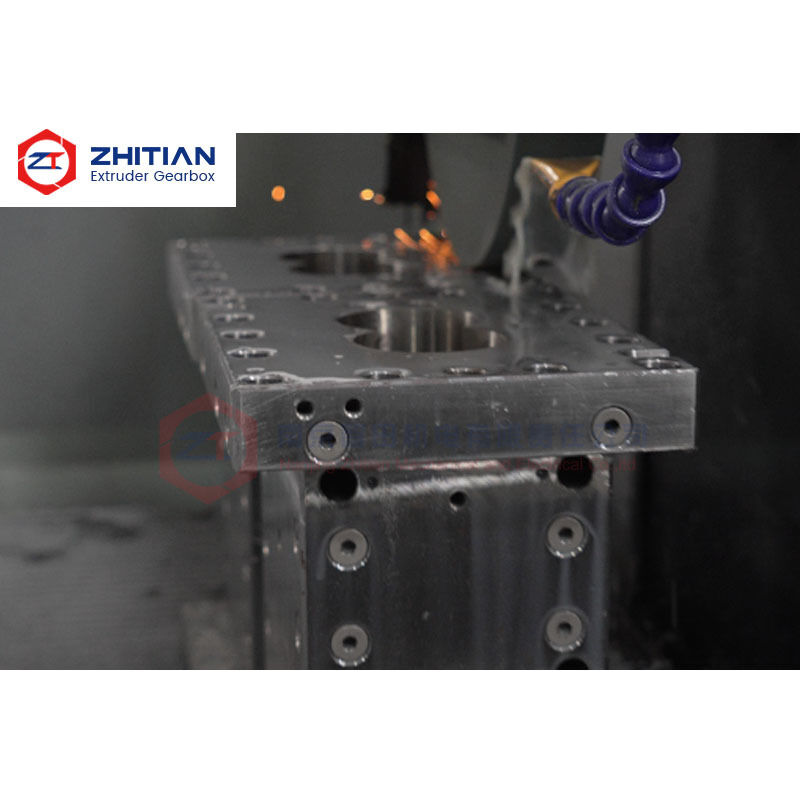
This wear resistant twin screw barrel is designed for high filler masterbatch production where calcium carbonate, talc, pigments and other abrasive powders create continuous wear on the barrel bore.
High filler formulations can place much greater abrasive load on the barrel than standard polymer processing. As the inner bore wears, the clearance between the screw elements and barrel gradually increases, which may reduce conveying efficiency, pressure stability and overall process consistency.
By selecting suitable wear-resistant materials or alloy-lined bore structures for critical barrel sections, the service life of high-wear zones can be improved without unnecessarily upgrading the entire barrel set.
Typical problems include:
- Rapid barrel bore wear
- Enlarged screw-to-barrel clearance
- Material backflow in worn sections
- Reduced conveying efficiency
- Unstable pressure development
- Frequent replacement of high-wear barrel sections
- Accelerated wear around filler feeding and mixing zones
Key Specifications
| Item |
Available Configuration |
| Product type |
Wear resistant twin screw barrel |
| Main application |
High filler masterbatch production |
| Typical fillers |
Calcium carbonate, talc, mineral powder and pigments |
| Barrel types |
Closed, feeding, side-feeding, venting and customized sections |
| Material options |
Tool steel, alloy-lined and customized wear-resistant systems |
| Bore protection |
Wear-resistant liner or alloy working surface |
| Manufacturing basis |
Drawing, sample or measured dimensions |
| Temperature control |
Customized heating holes and cooling channels |
| Critical inspection |
Bore, center distance, interfaces and surface condition |
| Main purpose |
Reduce abrasive bore wear and maintain working clearance |
Why High Filler Masterbatch Causes Severe Barrel Wear
High filler masterbatch production often involves a much higher concentration of solid particles than conventional polymer compounding.
Typical materials may include:
- Calcium carbonate
- Talc
- Mica
- Titanium dioxide
- Pigments
- Flame-retardant powders
- Other functional mineral fillers
During extrusion, these particles are transported, compressed, mixed and dispersed between the screw elements and barrel bore.
Repeated contact creates abrasive wear, especially in areas where filler concentration, pressure or mixing intensity is high.
The wear rate can become more severe when the process also involves:
- High filler percentage
- High screw speed
- High throughput
- Long continuous production cycles
- Hard or irregular filler particles
- Intensive downstream mixing
For this reason, barrel material selection should reflect the actual filler system rather than only the machine size.
Protect the Most Critical Wear Zones
Wear is usually not distributed evenly across the complete extrusion line.
More severe barrel wear often appears around:
- Main filler feeding sections
- Side-feeding sections
- Mixing and kneading zones
- Restrictive sections
- Pressure-building zones
- Sections processing highly concentrated filler
This means the entire barrel set does not necessarily require the same premium material.
A practical solution is to use higher wear-resistant materials in the sections exposed to the greatest abrasive load while using more economical materials in lower-wear positions.
This helps balance service life and replacement cost.
Maintain Screw-to-Barrel Clearance
The barrel bore and screw elements work together as one system.
As the bore diameter increases through wear, the operating clearance becomes larger.
Excessive clearance may cause:
- Increased material leakage or backflow
- Reduced forward conveying efficiency
- Lower pressure-building capability
- Less stable mixing behavior
- Output fluctuation
- Higher energy consumption for the same process result
For this reason, barrel wear should not be evaluated only by visual appearance.
Actual bore measurements and screw condition should be considered together when deciding whether replacement is necessary.
If both the screw elements and barrel are heavily worn, replacing only one component may not fully restore the original working condition.
Wear-Resistant Material Options
Different masterbatch formulations create different levels of wear.
Depending on the process, material options may include:
Tool Steel
Tool steels such as W6Mo5Cr4V2 can be considered for applications requiring greater wear resistance than conventional nitrided barrel materials.
Alloy-Lined Barrel
For more severe abrasive conditions, an alloy-lined structure can provide a higher-performance working surface while retaining the structural barrel body.
Customized Wear-Resistant Alloy Systems
For extremely abrasive formulations, the bore material can be selected according to filler type, filler loading and existing wear pattern.
The highest hardness is not always the best choice. Material selection should also consider toughness, corrosion conditions, processing temperature and the actual failure mechanism.
Replacement for Existing Twin Screw Extruders
Wear-resistant barrel sections can be manufactured according to:
- Original technical drawings
- Existing barrel samples
- Measured dimensions
- Machine interface data
- Process requirements
Customizable features include:
- Bore geometry
- Center distance
- Barrel length
- Liner material
- Connection faces
- Positioning features
- Bolt-hole pattern
- Feeding and side-feeding ports
- Venting openings
- Heating holes
- Cooling channels
- Sensor locations
When an existing worn barrel is used as the reference, original design dimensions should be distinguished from dimensions already changed by wear.
Manufacturing and Inspection
Critical inspection can include:
- Bore dimensions
- Center distance
- Bore geometry
- Parallelism
- Barrel length
- Connection-face accuracy
- Positioning dimensions
- Port locations
- Cooling-channel sealing
- Surface condition
- Material verification
For repeat replacement projects, confirmed dimensional data can be retained to improve consistency in future orders.
Information Required for Technical Evaluation
Please provide:
- Extruder brand and model
- Barrel drawing or sample
- Polymer type
- Filler type
- Filler percentage
- Screw speed
- Approximate throughput
- Existing barrel material
- Current barrel service life
- Wear photographs
- Most severely worn barrel position
- Required quantity
Frequently Asked Questions
Which barrel sections usually wear fastest in high filler masterbatch production?
Wear is often more severe near filler feeding, intensive mixing and pressure-building zones.
Does every barrel section need a wear-resistant liner?
No. Higher-performance materials can be concentrated in the sections where abrasive wear is most severe.
Should screw elements also be inspected?
Yes. Screw and barrel wear together determine the actual working clearance.
Can the barrel material be upgraded during replacement?
Yes. If the original material wears too quickly, the working surface material can be upgraded while maintaining the required replacement dimensions.
Request a High Filler Barrel Wear Review
Send us your barrel drawing, filler formulation and current wear condition.
We can help evaluate which barrel sections require upgraded wear protection, whether the current material is suitable and which dimensions should be confirmed before replacement.
Send Your Barrel Drawing for Wear Evaluation


 Your message must be between 20-3,000 characters!