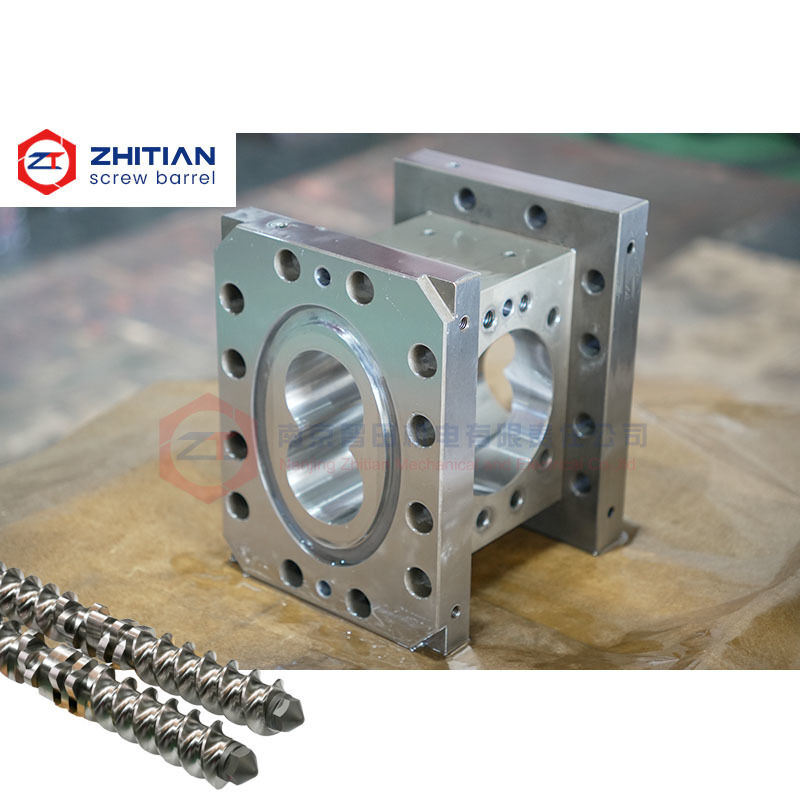
This modular twin screw extruder barrel is designed for users who need to replace an individual worn, damaged or functionally unsuitable barrel section without changing the complete barrel set.
Each section can be manufactured to match the existing barrel assembly, including the bore, center distance, overall length, positioning surfaces, bolt holes and connection dimensions.
It provides a practical solution when:
-
Only one or two barrel sections are severely worn
-
A feeding, venting or side-feeding section is damaged
-
The process requires a different port configuration
-
A replacement section does not align correctly with adjacent barrels
-
The user wants to reduce the cost of replacing a complete barrel set
-
Production downtime must be limited during maintenance
Key Specifications
| Item |
Specification |
| Product type |
Modular twin screw extruder barrel section |
| Structure |
Segmented modular construction |
| Available sections |
Closed, feeding, venting, vacuum and side-feeding |
| Manufacturing basis |
Drawing, used sample or measured dimensions |
| Connection matching |
Positioning surfaces, bolt holes and adjacent interfaces |
| Material options |
Nitrided steel, tool steel, bimetallic or alloy-lined structure |
| Customization |
Length, bore, ports, channels and connection dimensions |
| Inspection |
Bore, center distance, interface dimensions and assembly matching |
| Main purpose |
Individual section replacement and process modification |
Replace Only the Worn Barrel Section
Wear is not always distributed evenly across the complete extruder barrel.
Feeding zones, melting zones, kneading zones and high-pressure sections can experience different levels of wear. In many cases, one section reaches its service limit while the remaining sections are still usable.
A modular replacement allows the affected section to be changed independently.
This can help users:
-
Reduce replacement cost
-
Retain usable barrel sections
-
Shorten maintenance preparation
-
Reduce spare-part inventory
-
Respond faster to localized wear or damage
Before replacement, the adjacent barrels and screw elements should also be checked. The new section must work correctly with the existing assembly rather than being evaluated separately.
Match the Existing Barrel Assembly
Barrels with the same nominal size are not always interchangeable.
Different extruders may use different lengths, bore geometries, center distances, bolt-hole layouts, positioning structures and temperature-control arrangements.
The following dimensions are normally confirmed:
-
Inner bore dimensions
-
Center distance
-
Barrel length
-
Front and rear connection surfaces
-
Positioning steps
-
Bolt-hole diameter and location
-
Alignment features
-
Port position and dimensions
-
Heating and cooling interfaces
The objective is to ensure that the new section connects correctly with the adjacent barrels and maintains a continuous internal flow path.
Prevent Misalignment Between Barrel Sections
Incorrect matching between adjacent barrels can create an internal step, bore offset or uneven connection surface.
These problems may cause:
-
Material retention at the joint
-
Local overheating or degradation
-
Pressure fluctuation
-
Abnormal wear near the connection
-
Leakage between sections
-
Assembly difficulties
Original drawings are preferred. When drawings are unavailable, a used sample and complete dimensional information can be used for reverse measurement.
Worn dimensions should be identified and corrected rather than copied directly.
Available Functional Barrel Sections
Closed Barrel Section
Used in conveying, melting, mixing and pressure-building zones.
Feeding Barrel Section
Manufactured with a main feeding opening and matched to the existing hopper or feeding system.
Venting or Vacuum Barrel Section
Used to remove air, moisture or volatile components. The opening and flange can be customized according to the process.
Side-Feeding Barrel Section
Designed for adding glass fiber, mineral fillers, additives or other materials at a selected process position.
An individual functional section can also be changed as part of a process modification without rebuilding the complete barrel assembly.
Material Selection by Process Position
Different sections may require different material solutions.
A standard nitrided-steel section can be used for general compounding with moderate wear. Sections exposed to severe abrasion, pressure or corrosion may require upgraded protection.
Available options include:
-
38CrMoAlA with nitrided bore
-
Tool-steel liner
-
Bimetallic liner
-
Nickel-based wear-resistant liner
-
Laser-clad inner bore
-
Integral alloy sleeve
-
Corrosion-resistant alloy system
The complete barrel set does not always need to use the same material.
Wear-resistant materials can be concentrated in high-wear zones, while less demanding sections use a more economical configuration.
Inspection for Interchangeable Assembly
Inspection focuses on both the individual section and its compatibility with the existing barrel assembly.
Inspection items can include:
Dimensional records can be retained for future repeat orders.
Information Required for Replacement
Please provide:
-
Extruder brand and model
-
Position of the damaged barrel section
-
Original drawing, when available
-
Used sample or detailed photographs
-
Bore diameter and center distance
-
Overall length
-
Front and rear connection dimensions
-
Bolt-hole and positioning details
-
Port type and dimensions
-
Processed material and filler content
-
Description of the wear or process problem
-
Required quantity
Information about the adjacent sections is also helpful for checking assembly compatibility.
Frequently Asked Questions
Can one barrel section be replaced without replacing the complete set?
Yes, provided that the adjacent sections, screw elements and connection dimensions remain within an acceptable condition.
Can you manufacture a section without the original drawing?
Yes. A used sample and dimensional information can be used, but worn or deformed dimensions must first be identified and corrected.
Can a closed section be changed to a venting or side-feeding section?
In some cases, yes. The installation space, process arrangement, auxiliary equipment and connection dimensions must be evaluated first.
Do all barrel sections need the same material?
No. Different materials can be selected for different process zones according to wear, corrosion and pressure conditions.
Request an Individual Barrel Section Review
Send us the drawing, sample information and installation position of the section that needs replacement.
-
Whether only the damaged section can be replaced
-
Which connection dimensions must be confirmed
-
Whether the adjacent sections remain usable
-
Whether the material should be upgraded
-
Whether the section can be modified for feeding, venting or side feeding
Send Your Barrel Section Drawing for Compatibility Review


 Your message must be between 20-3,000 characters!