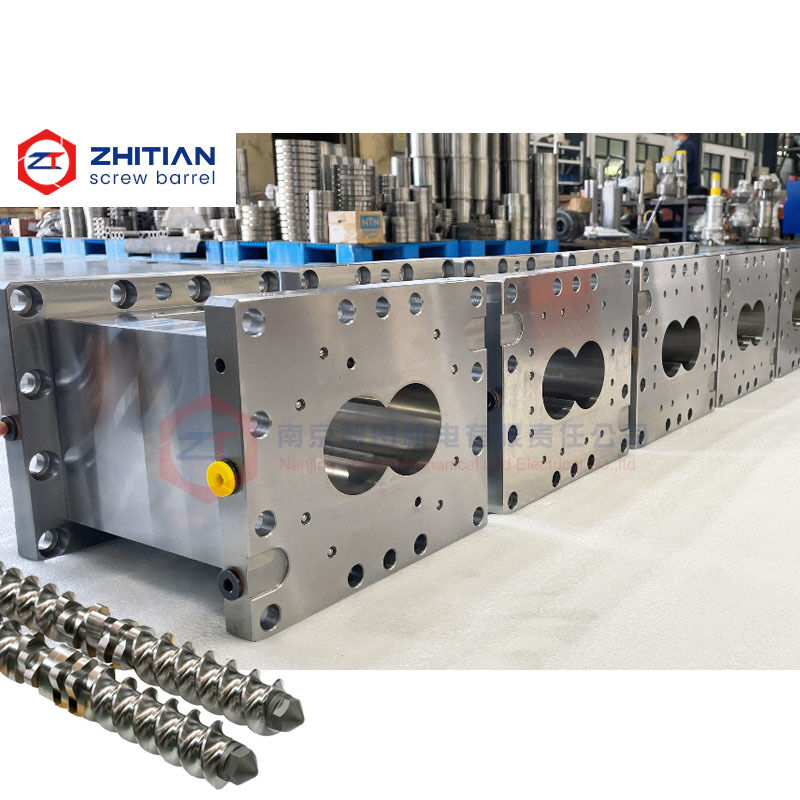
A twin screw extrusion line does not expose every barrel section to the same operating conditions.
Feeding, melting, mixing, venting and pressure-building zones have different requirements for opening design, temperature control, wear protection and material flow. Using the same barrel configuration throughout the line may lead to unstable feeding, ineffective venting, localized wear or fluctuating melt pressure.
This custom process-zone twin screw extruder barrel is manufactured according to the function of each position in the extrusion process. Barrel structure, openings, internal protection, heating holes and cooling channels can be configured based on the processed material and existing machine layout.
It helps solve problems such as:
- Irregular material intake in the feeding zone
- Material accumulation around barrel connections
- Insufficient venting or devolatilization
- Localized wear in high-shear process zones
- Unstable pressure before the die
- Incorrect port configuration after a process change
- One barrel material being used for several different wear conditions
Key Specifications
| Item |
Available Configuration |
| Product type |
Process-specific twin screw extruder barrel |
| Barrel structure |
Modular segmented construction |
| Available sections |
Closed, feeding, venting, vacuum and side-feeding |
| Manufacturing basis |
Drawing, sample or measured dimensions |
| Process configuration |
Feeding, melting, mixing, venting and pressure-building zones |
| Material options |
Nitrided steel, tool steel, bimetallic liner and alloy protection |
| Temperature control |
Customized heating holes, cooling channels and sensor positions |
| Port customization |
Main feed, side feed, atmospheric vent and vacuum opening |
| Inspection |
Bore, center distance, ports, interfaces and channel sealing |
| Main purpose |
Stable material flow and process-zone optimization |
Configure the Barrel Around the Extrusion Process
The barrel is more than an external housing for the screw elements. Its bore, openings, temperature-control layout and internal material protection influence how the material moves through each process stage.
A process-specific configuration considers:
- Where the raw material enters the machine
- Where melting begins
- Where intensive mixing takes place
- Where fillers or fibers are added
- Where moisture or volatile components are removed
- Where pressure is developed before discharge
The objective is not simply to reproduce the external dimensions of the original barrel. The replacement should also support the function of its actual process position.
Improve Material Intake in the Feeding Zone
Poor feeding can cause output fluctuations, incomplete filling and unstable downstream pressure.
The feeding barrel opening must match the material form and feeding system. Powder, pellets, flakes and low-density bulk materials may require different opening dimensions and transition structures.
The feeding section can be customized according to:
- Main feeder dimensions
- Material bulk density
- Required feeding capacity
- Opening length and width
- Hopper connection
- Cooling-channel position
- Adjacent barrel interfaces
A correctly configured feeding and venting barrel helps the extrusion line receive material more consistently without unnecessarily changing the complete machine arrangement.
Support Effective Venting and Devolatilization
Venting sections are used to release trapped air, moisture or volatile components from the material.
An unsuitable opening position or insufficient free volume may reduce venting efficiency. Material may also escape through the vent when the screw configuration, filling level or pressure distribution is not appropriate.
A customized venting or vacuum barrel can include:
- Atmospheric vent opening
- Vacuum connection
- Customized flange
- Enlarged opening area
- Condensate or collection interface
- Matching connection for existing vacuum equipment
Barrel design alone cannot correct every devolatilization problem. Screw configuration, feed rate, melt temperature, vacuum level and upstream filling condition should also be evaluated.
Reduce Localized Wear in High-Load Zones
Barrel wear is often concentrated in specific areas rather than distributed evenly along the complete extrusion line.
High-shear mixing zones, glass-fiber feeding positions and pressure-building sections may experience more severe abrasion than conventional conveying zones.
Instead of using the same material for every section, different protection systems can be selected according to the process position.
Available options include:
- 38CrMoAlA with nitrided bore for moderate wear
- Tool-steel liner for abrasive compounds
- Bimetallic liner for improved service life
- Nickel-based wear-resistant alloy
- Laser-clad inner bore
- Integral alloy sleeve
- Corrosion-resistant alloy system
This zone-based approach allows higher-performance materials to be applied where wear is most severe, while less demanding sections retain a more economical configuration.
Maintain Stable Flow Between Adjacent Sections
The internal flow path should remain continuous across all barrel connections.
Bore misalignment, internal steps or incorrect positioning between adjacent sections may cause:
- Material retention
- Local overheating
- Polymer degradation
- Pressure fluctuation
- Increased wear near the joint
- Difficult cleaning during material changes
Critical matching dimensions include:
- Bore geometry
- Center distance
- Overall length
- Connection surfaces
- Positioning steps
- Bolt-hole locations
- Port positions
- Heating and cooling interfaces
These details should be confirmed from an original drawing, an existing sample or complete dimensional measurements.
Adapt the Barrel for Process Changes
Production requirements may change after the extrusion line has been installed.
A customer may need to:
- Add a side feeder
- Introduce vacuum venting
- Change the main feeding position
- Process a more abrasive formulation
- Improve cooling in one process zone
- Add a temperature sensor
- Convert a closed section into a functional section
In suitable cases, a process-specific barrel section can support these changes without replacing the complete barrel assembly.
However, available installation space, screw configuration, auxiliary equipment and machine-frame structure must be checked before making a functional modification.
Manufacturing and Inspection
A customized barrel must match both the machine dimensions and the intended process function.
Inspection items can include:
- Inner bore dimensions
- Center distance
- Bore geometry
- Overall length
- Parallelism
- Connection-face accuracy
- Positioning dimensions
- Port location and size
- Bolt-hole layout
- Heating-hole position
- Cooling-channel sealing
- Alignment with adjacent sections
Inspection records can be retained to support repeat orders and future maintenance.
Information Required for Technical Evaluation
Please provide:
- Extruder brand and machine information
- Position of the required barrel section
- Original drawing, when available
- Used barrel sample or dimensional measurements
- Bore and center-distance dimensions
- Barrel length and connection structure
- Existing port type
- Required feeding, venting or side-feeding function
- Heating and cooling arrangement
- Processed material
- Filler type and percentage
- Current production problem
- Required quantity
The processed formulation and operating problem are important because they help determine the appropriate barrel structure and material.
Frequently Asked Questions
Can different barrel sections use different materials?
Yes. Materials can be selected according to the wear, corrosion and pressure conditions of each process zone.
Can a closed barrel be changed into a venting section?
It may be possible, but the screw configuration, available installation space, vacuum system and process pressure must be evaluated first.
Can the feeding opening be customized?
Yes. The opening dimensions and connection structure can be matched to the existing feeder, hopper and material characteristics.
Can a barrel modification solve unstable extrusion output?
It may help when the instability is related to feeding, venting, bore wear or an unsuitable barrel configuration. Screw condition, feeder performance, process settings and drive load should also be checked.
Request a Process-Zone Configuration Review
Send us the barrel drawing, installation position and description of the current production problem.
We can help evaluate:
- Whether the barrel function matches its process position
- Whether the feeding or venting structure should be modified
- Whether localized wear requires a material upgrade
- Whether the existing interfaces can be retained
- Which dimensions must be confirmed before manufacturing
Send Your Process Requirements for Barrel Configuration Review


 Your message must be between 20-3,000 characters!