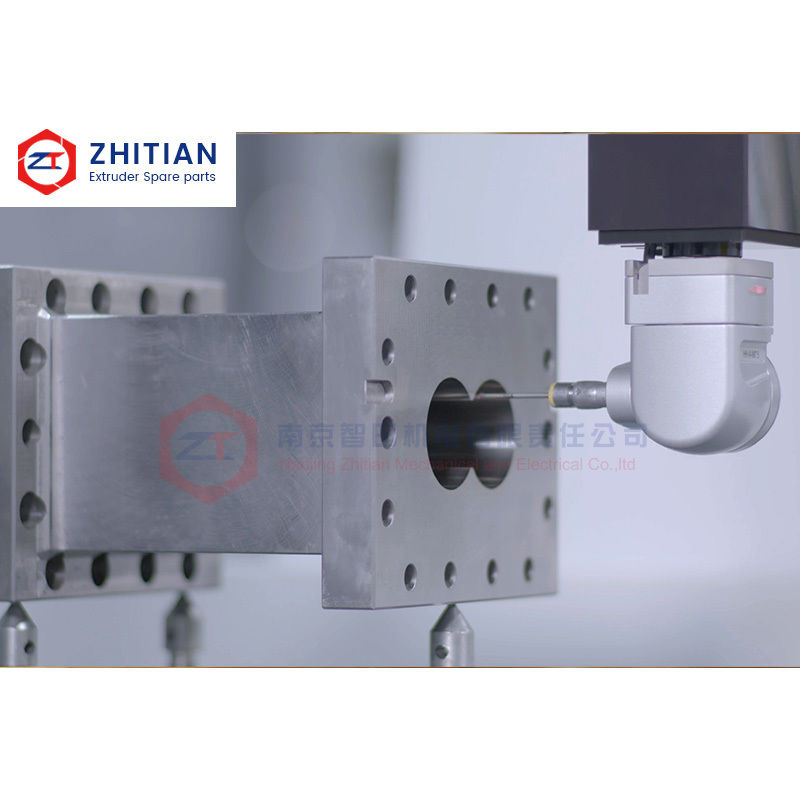
This nickel-based alloy lined twin screw barrel is designed for extrusion processes where the barrel bore is exposed to demanding media that can cause corrosion, abrasion or a combination of both.
In these applications, selecting the barrel only by hardness may not provide the expected service life. A material with strong wear resistance can still suffer from chemical attack, while a corrosion-resistant material may wear rapidly when abrasive fillers are also present.
A nickel-based alloy liner provides an alternative working surface for applications where corrosion resistance and mechanical durability must be considered together.
Typical problems include:
- Pitting or chemical attack on the barrel bore
- Combined corrosion and abrasive wear
- Rapid loss of bore geometry
- Increasing screw-to-barrel clearance
- Localized damage in specific process zones
- Frequent replacement of conventional barrel sections
- Difficulty selecting material only from hardness values
Key Specifications
| Item |
Available Configuration |
| Product type |
Nickel-based alloy lined twin screw barrel |
| Main application |
Demanding and chemically aggressive extrusion processes |
| Main feature |
Nickel-based alloy working bore |
| Protection focus |
Corrosion, abrasion or combined damage |
| Barrel types |
Closed, feeding, venting, side-feeding and customized sections |
| Manufacturing basis |
Drawing, sample or measured dimensions |
| Temperature control |
Customized heating holes and cooling channels |
| Process interfaces |
Feeding, venting, side-feeding and customized ports |
| Critical inspection |
Bore, center distance, interfaces and liner condition |
| Main purpose |
Maintain bore protection under demanding process media |
When Should a Nickel-Based Alloy Liner Be Considered?
A nickel-based liner is not necessary for every twin screw extrusion process.
For standard polymers with moderate wear and limited chemical attack, conventional barrel materials may already provide an economical solution.
Nickel-based alloy systems become more relevant when the process includes:
- Corrosive additives
- Reactive chemical components
- Moisture combined with aggressive chemicals
- Certain flame-retardant or functional formulations
- Abrasive fillers together with corrosive media
- Elevated processing temperatures
- Repeated corrosion concentrated in the same barrel zone
The selection should start with the actual failure mechanism of the existing barrel.
If the bore shows pitting, chemical erosion or a combination of surface attack and mechanical wear, simply increasing material hardness may not solve the problem.
Corrosion and Wear Must Be Evaluated Together
Many demanding compounds do not create only one type of damage.
For example, a formulation may contain mineral powder or reinforcement that causes abrasion while also containing additives that chemically attack the barrel surface.
In this situation, barrel damage can develop through both mechanisms at the same time.
Possible results include:
- Roughened bore surfaces
- Local pitting
- Accelerated dimensional loss
- Uneven working clearance
- Increased material retention
- Shorter replacement intervals
The liner material should therefore be selected according to the balance between corrosion resistance, wear resistance, toughness and operating temperature.
The highest hardness is not automatically the best material.
Maintain the Working Bore Geometry
The purpose of an alloy liner is not only to create a more resistant surface.
It also helps preserve the geometry of the barrel bore.
As corrosion or wear removes material from the working surface, the clearance between the screw elements and barrel increases.
Excessive clearance may contribute to:
- Material backflow
- Lower conveying efficiency
- Reduced pressure-building capability
- Changes in mixing behavior
- Process instability
- Further wear of the screw-barrel system
For replacement projects, the condition of the screw elements should therefore be inspected together with the barrel.
A new barrel cannot fully restore the original working clearance if the screw elements are already severely worn.
Use Nickel-Based Protection Only Where Required
In a segmented twin screw extruder, not every barrel section operates under the same conditions.
More demanding zones may include:
- Additive injection sections
- Reactive processing zones
- Side-feeding sections
- Intensive mixing zones
- Venting or devolatilization areas
- Sections exposed to corrosive by-products
For this reason, the complete barrel set does not always need the same liner material.
Nickel-based alloy protection can be concentrated in the sections where corrosion or combined wear is most severe, while less demanding zones can use more economical materials.
This helps balance material performance and replacement cost.
Custom Replacement for Existing Equipment
Nickel-based alloy lined barrels can be manufactured according to:
- Original technical drawings
- Existing barrel samples
- Measured dimensions
- Machine interface data
- Actual process requirements
Customizable features include:
- Bore geometry
- Center distance
- Barrel length
- Liner material
- Connection faces
- Positioning features
- Feeding and venting ports
- Side-feeder interfaces
- Heating holes
- Cooling channels
- Sensor locations
When a worn barrel is used as the manufacturing reference, dimensions affected by corrosion or wear should first be identified.
The replacement should restore the required geometry rather than reproduce damage from the old component.
Manufacturing and Inspection
Critical inspection can include:
- Inner-bore dimensions
- Center distance
- Bore geometry
- Parallelism
- Barrel length
- Connection-face accuracy
- Positioning dimensions
- Port locations
- Cooling-channel sealing
- Liner surface condition
- Material verification
Confirmed dimensional data can be retained for future repeat replacement orders.
Information Required for Material Evaluation
Please provide:
- Extruder brand and model
- Barrel drawing or sample
- Processed polymer
- Additives or chemical components
- Filler or reinforcement type
- Processing temperature
- Screw speed
- Approximate throughput
- Existing barrel material
- Current service life
- Corrosion or wear photographs
- Location of the most severe damage
- Required quantity
Frequently Asked Questions
Is a nickel-based liner always better than nitrided steel?
No. The correct material depends on the process. Conventional nitrided materials may be sufficient for moderate conditions, while nickel-based alloys are more useful when corrosion or combined damage becomes important.
Is hardness the main criterion for selecting the liner?
No. Corrosion resistance, wear resistance, toughness, temperature and actual process media should all be considered.
Can only the damaged barrel section be upgraded?
Yes. In segmented extrusion systems, higher-performance liner materials can often be concentrated in the most severely affected sections.
Should the screw elements also be checked?
Yes. Screw and barrel wear together determine the actual working clearance.
Request a Nickel-Based Barrel Material Review
Send us your barrel drawing, processed material and current corrosion or wear condition.
We can help evaluate the dominant failure mechanism, whether a nickel-based alloy liner is appropriate, which barrel sections require upgraded protection and which dimensions should be confirmed before replacement.
Send Your Barrel Drawing and Process Media for Material Evaluation


 Your message must be between 20-3,000 characters!