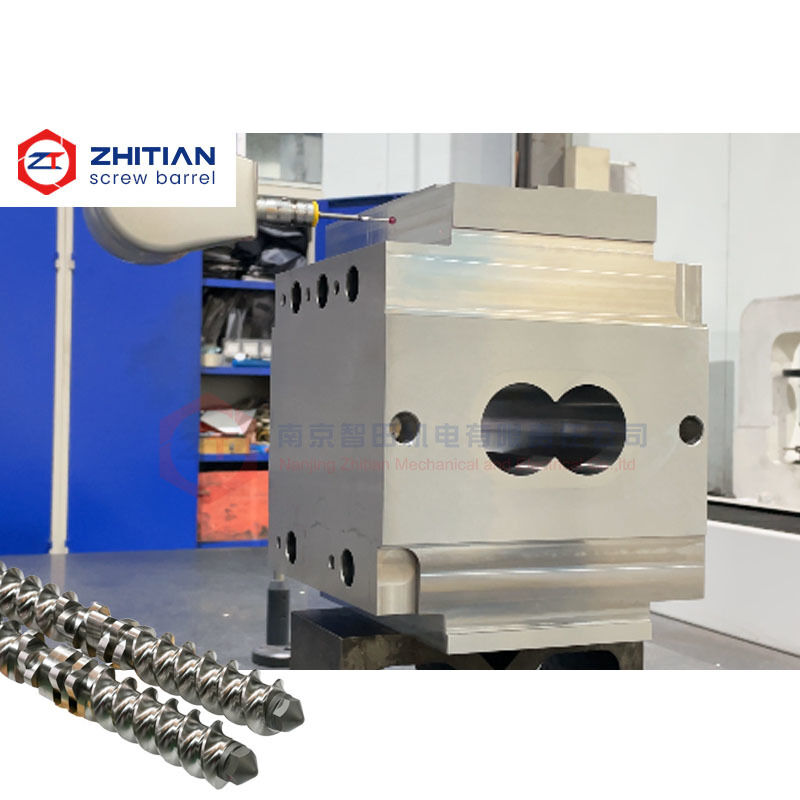
This twin screw extruder barrel is designed with independently configured heating and cooling circuits for individual barrel sections.
It allows different process zones to operate at different target temperatures instead of relying on one uniform thermal condition across the complete extrusion line.
The design helps users address common processing problems such as:
- Temperature interference between adjacent barrel sections
- Slow response when process temperatures need adjustment
- Unstable melt temperature during long production runs
- Overheating in high-shear mixing zones
- Insufficient cooling near feeding or side-feeding positions
- Batch-to-batch variation caused by inconsistent thermal conditions
- Difficulty processing materials with different thermal requirements
The heating holes, cooling channels, sensor positions and connection interfaces can be customized according to the original barrel drawing, used sample and extrusion process.
Key Specifications
| Item |
Available Configuration |
| Product type |
Temperature-controlled twin screw extruder barrel |
| Barrel structure |
Modular segmented construction |
| Temperature control |
Independent heating and cooling by barrel section |
| Available sections |
Closed, feeding, venting, vacuum and side-feeding |
| Heating configuration |
Customized heater holes or heating interfaces |
| Cooling configuration |
Independent water channels with customized inlet and outlet positions |
| Sensor configuration |
Customized temperature sensor holes |
| Manufacturing basis |
Drawing, used sample or measured dimensions |
| Material options |
Nitrided steel, tool steel, bimetallic and alloy-lined structures |
| Inspection |
Dimensions, channel position and sealing performance |
| Main purpose |
Reduce thermal interference and stabilize process temperature |
Control Each Process Zone Independently
Different stages of twin screw extrusion do not always require the same temperature.
The feeding zone may require cooling to prevent premature softening or material bridging. Melting and mixing zones may require controlled heating, while high-shear sections may generate sufficient internal heat and require additional cooling.
An independently controlled barrel configuration allows the temperature of each section to be adjusted according to its actual process function.
This provides greater flexibility when processing:
- Heat-sensitive polymers
- Engineering plastics
- Color and additive masterbatch
- Reactive formulations
- Materials with narrow processing windows
- Compounds requiring staged melting
- Products that are frequently changed on the same extrusion line
Reduce Thermal Interference Between Adjacent Sections
Heat can transfer from one barrel section to the next through the barrel body, connection surfaces and processed material.
When adjacent zones have significantly different temperature requirements, this thermal interaction may make temperature control less responsive.
Possible consequences include:
- The feeding section becoming too hot
- Premature melting near the feed opening
- Material bridging or irregular feeding
- Excessive melt temperature in the mixing zone
- Longer cooling time after a product change
- Frequent manual adjustment of temperature settings
Independent heating and cooling channels cannot completely eliminate heat transfer, but they provide better control over how each barrel section responds to process changes.
The final temperature condition also depends on screw speed, throughput, shear energy, material properties and cooling-water conditions.
Improve Temperature Stability in High-Shear Zones
Mechanical shear generated by the rotating screw elements can create a significant amount of heat.
In intensive kneading, mixing and pressure-building zones, the material temperature may continue to rise even when external heaters are switched off.
A barrel section with a dedicated cooling circuit can remove part of this excess heat and help maintain a more stable processing window.
This may help reduce:
- Polymer degradation
- Discoloration
- Changes in viscosity
- Excessive volatile generation
- Unstable melt pressure
- Variation in final product properties
Cooling-channel configuration should be evaluated together with screw design and operating conditions. A barrel modification alone cannot correct excessive shear caused by an unsuitable screw configuration.
Support Stable Feeding Conditions
Temperature control near the main feeding and side-feeding zones is especially important for materials that soften easily or have low bulk density.
If the feeding barrel becomes too warm, material may stick to the barrel opening or begin melting before it enters the intended process zone.
This may cause:
- Irregular material intake
- Feeding fluctuation
- Lower production output
- Material accumulation near the feed port
- Increased cleaning frequency
Dedicated cooling channels can be arranged around the feeding section according to the opening size, feeder position and available barrel structure.
The cooling layout should avoid weakening critical structural areas or interfering with bolt holes and connection surfaces.
Customized Heating and Cooling Layout
The thermal-control system can be manufactured according to the original machine arrangement or customized for a revised process.
Available customization includes:
- Heater-hole quantity and position
- Heater-hole diameter and depth
- Cooling-channel direction
- Cooling-water inlet and outlet positions
- Independent circuits for individual sections
- Temperature sensor location
- Port and flange arrangement
- Interfaces for existing hoses or pipework
- Sealing structure
- Connection dimensions with adjacent barrels
For replacement projects, the new barrel should connect to the existing heating, cooling and sensor system without requiring unnecessary modification to the machine.
Choose the Barrel Material Separately from Thermal Design
The temperature-control structure and barrel wear material are two separate design decisions.
A standard nitrided barrel may be suitable for general polymer processing with moderate wear. More demanding applications may require additional bore protection.
Available material options include:
- 38CrMoAlA with nitrided bore
- Tool-steel liner
- Bimetallic liner
- Nickel-based wear-resistant liner
- Laser-clad inner bore
- Integral alloy sleeve
- Corrosion-resistant alloy system
The material should be selected according to abrasion, corrosion, pressure and cleaning conditions rather than only the temperature requirement.
Manufacturing and Channel Inspection
Heating and cooling features must be accurately positioned because they are located close to the bore, bolt holes and connection structures.
Inspection can include:
- Inner-bore dimensions
- Center distance
- Overall barrel length
- Connection-face accuracy
- Heater-hole position and depth
- Cooling-channel position
- Inlet and outlet dimensions
- Temperature sensor position
- Channel continuity
- Cooling-channel sealing
- Alignment with adjacent sections
Pressure or sealing tests can be performed on cooling channels before shipment.
Inspection records can also be retained for future repeat orders.
Information Required for Technical Evaluation
Please provide:
- Original barrel drawing or used sample
- Barrel position in the extrusion process
- Existing heating method
- Existing cooling-channel layout
- Cooling-water inlet and outlet positions
- Temperature sensor arrangement
- Current target temperature for each zone
- Actual temperature fluctuation
- Processed material
- Screw speed and approximate throughput
- Description of the current thermal problem
- Required quantity
Temperature data from actual production can help determine whether the main problem comes from the barrel, process settings, screw configuration or cooling system.
Frequently Asked Questions
Can every barrel section have a separate cooling circuit?
Yes, when the barrel structure and available space allow it. The channel layout must be coordinated with bolt holes, ports, heating holes and connection surfaces.
Can independent cooling prevent overheating completely?
Not necessarily. Overheating may also be caused by excessive screw speed, high shear, restricted material flow or an unsuitable screw configuration. The complete process should be evaluated.
Can the new barrel connect to the existing heating and cooling system?
Yes. Inlet positions, outlet positions, heater holes and sensor interfaces can be matched to the original arrangement when accurate dimensions are provided.
Is independent temperature control useful for frequent material changes?
Yes. Separate barrel-zone control can make it easier to adjust different process sections during product changes, although the actual response time also depends on barrel mass, heating power and cooling-water conditions.
Request a Temperature-Control Configuration Review
Send us your barrel drawing, existing heating and cooling layout, and current temperature-control problem.
We can help evaluate:
- Which barrel sections require independent cooling
- Whether heating or sensor positions should be changed
- Whether adjacent temperature zones are interfering with each other
- Whether the existing cooling interfaces can be retained
- Which dimensions must be confirmed before manufacturing
Send Your Temperature-Zone Requirements for Technical Review


 Your message must be between 20-3,000 characters!