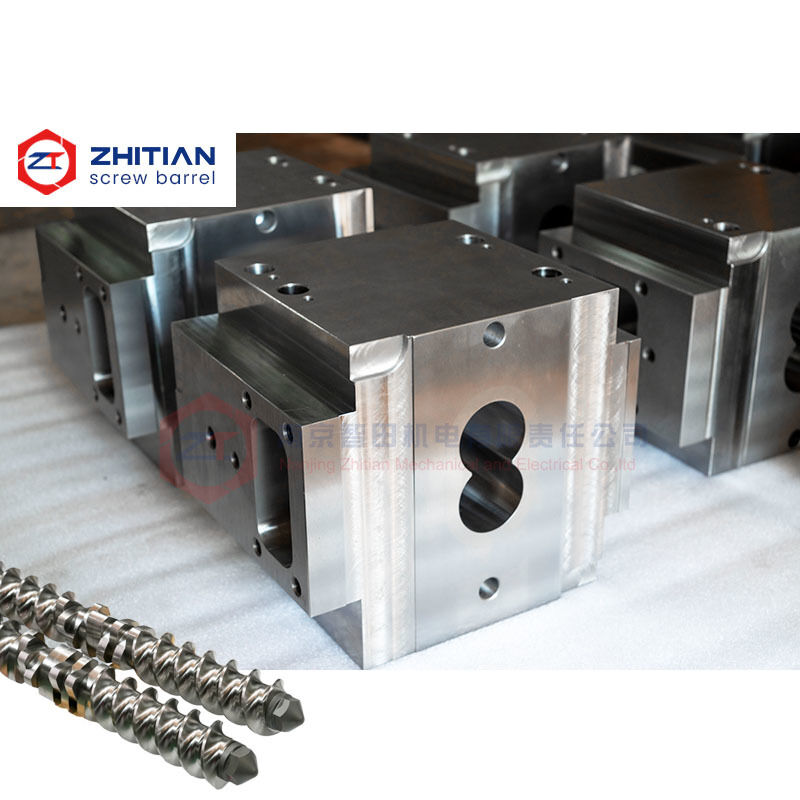
This wear-resistant twin screw extruder barrel is designed for compounding processes where glass fiber, mineral fillers, pigments or corrosive additives cause rapid inner-bore wear.
Instead of selecting the barrel only by machine size, the material system is matched to the processed formulation, filler percentage, wear position and corrosion conditions.
The objective is to help users reduce:
- Rapid enlargement of the barrel bore
- Loss of screw-to-barrel clearance
- Unstable output and melt pressure
- Frequent barrel replacement
- Localized wear in high-shear zones
- Corrosion caused by aggressive formulations
- Performance loss after installing new screw elements
Key Specifications
| Item |
Available Configuration |
| Product type |
Wear-resistant twin screw extruder barrel |
| Main application |
Abrasive, filled and corrosive compounds |
| Base structure |
Solid barrel or barrel with replaceable liner |
| Material options |
Nitrided steel, tool steel, bimetallic alloy and wear-resistant liner |
| Bore protection |
Nitriding, laser cladding or integral alloy sleeve |
| Corrosion protection |
Nickel-based or corrosion-resistant alloy options |
| Customization basis |
Drawing, used sample or measured dimensions |
| Available barrel types |
Closed, feeding, venting and side-feeding |
| Inspection |
Bore, center distance, interfaces, material and channel sealing |
| Main purpose |
Reduce premature wear and extend replacement intervals |
Why Filled Compounds Wear Barrel Bores Faster
Fillers improve the mechanical, thermal or functional properties of polymer compounds, but many of them also increase barrel wear.
Common abrasive materials include:
- Glass fiber
- Calcium carbonate
- Talc
- Mica
- Silica
- Ceramic powder
- Flame-retardant fillers
- Magnetic or functional powders
- High pigment concentrations
These particles move between the rotating screw elements and the barrel bore under pressure. In high-shear and pressure-building zones, they can gradually remove material from the bore surface.
As the bore wears, the clearance between the screws and barrel increases. This may reduce conveying efficiency and weaken the control of shear, pressure and residence time.
A harder material is not always the complete answer. Material toughness, corrosion resistance, bonding method and the actual wear mechanism must also be considered.
Match the Barrel Material to the Formulation
Different formulations require different material solutions.
Nitrided Steel for Moderate Wear
A nitrided alloy-steel barrel can be suitable for general compounding and formulations with moderate abrasive content.
It provides a cost-effective solution where wear is limited and severe corrosion is not present.
Tool Steel for Abrasive Processing
Tool-steel liners or inner-bore structures can provide improved wear resistance for engineering plastics and filled compounds.
They may be considered for applications involving:
- Glass-fiber reinforcement
- Mineral-filled polymers
- High pigment loading
- Repeated production with abrasive additives
The specific grade should be selected according to the required balance between hardness, toughness and machinability.
Bimetallic or Alloy-Lined Barrel
A bimetallic liner combines a structural barrel body with a more wear-resistant inner layer.
This allows the inner bore to resist process wear while the outer body provides mechanical strength and supports the heating and cooling structure.
Laser-Clad Wear-Resistant Bore
Laser cladding can apply a wear-resistant alloy layer to the inner bore.
The metallurgical bond between the cladding layer and substrate helps reduce the risk of separation during thermal cycling. It can be used where both wear resistance and local surface reinforcement are required.
Integral Alloy Sleeve
An integral alloy sleeve provides a continuous wear-resistant inner structure.
It may be selected for severe or continuous abrasive service where a longer replacement interval is more important than the lowest initial cost.
Wear and Corrosion Can Occur Together
Some extrusion formulations create both abrasive wear and chemical attack.
Examples may include compounds containing:
- Corrosive flame retardants
- Halogen-containing additives
- Acidic components
- Reactive processing agents
- Battery-related materials
- Chemical or functional additives
In these applications, selecting only a high-hardness material may not provide sufficient service life.
Corrosion can weaken the bore surface, after which abrasive particles remove material more rapidly. The material system must therefore address both mechanisms.
Optional corrosion-resistant solutions include:
- Stainless steel
- Nickel-based alloy
- Nickel-based wear-resistant liner
- Corrosion-resistant laser cladding
- Customized alloy sleeve
The formulation, processing temperature and cleaning method should be provided before material selection.
Focus Protection on the Highest-Wear Zones
Wear is rarely uniform across the complete barrel assembly.
Severe wear commonly appears near:
- Main feeding zones
- Side-feeding positions
- Intensive kneading sections
- High-filler introduction points
- Pressure-building zones
- Sections operating with partially filled material
It is not always necessary to use the most expensive material for every barrel section.
A practical configuration may combine:
- Standard material in low-wear conveying zones
- Upgraded wear protection in intensive mixing zones
- Corrosion-resistant material in chemically aggressive sections
This helps control investment while concentrating protection where it creates the greatest operating value.
How Barrel Wear Affects Extrusion Performance
An excessively worn barrel may cause:
- Reduced extrusion output
- Unstable melt pressure
- Poor mixing consistency
- Increased material backflow
- Longer residence-time variation
- Local overheating
- More frequent process adjustments
In some cases, users replace the screw elements but do not see the expected recovery in output or product quality.
One possible reason is that the barrel bore has already worn beyond the acceptable clearance. New screw elements cannot fully restore performance inside an excessively enlarged bore.
The barrel and screw elements should therefore be inspected as one working system.
Custom Manufacturing for Existing Equipment
The barrel can be manufactured according to:
- Original technical drawings
- Used barrel samples
- Measured dimensions
- Machine and installation information
- Existing barrel-section interfaces
Customizable details include:
- Bore dimensions
- Center distance
- Overall length
- Connection surfaces
- Positioning dimensions
- Bolt-hole layout
- Feeding and venting openings
- Side-feeder interface
- Heating holes
- Cooling channels
- Temperature sensor holes
- Material and inner-bore protection
A used sample can be measured, but worn dimensions must be identified and corrected rather than copied directly.
Manufacturing and Quality Inspection
Before shipment, inspection can cover:
- Inner-bore dimensions
- Center distance
- Bore geometry
- Parallelism
- Overall length
- Connection-face accuracy
- Positioning dimensions
- Bolt-hole locations
- Port dimensions
- Heating-hole positions
- Cooling-channel sealing
- Material and heat-treatment condition
Inspection records can be retained to support future repeat orders and dimensional traceability.
Information Required for Material Selection
Please provide:
- Extruder information
- Original drawing or used sample
- Bore and center-distance dimensions
- Barrel position in the extrusion process
- Processed polymer
- Filler or reinforcement type
- Filler percentage
- Operating temperature
- Existing barrel material
- Current wear or corrosion pattern
- Expected service-life requirement
- Required quantity
Photographs of the worn bore can also help identify whether the main problem is abrasion, corrosion or a combination of both.
Frequently Asked Questions
Which barrel material is best for glass-fiber compounds?
The appropriate material depends on glass-fiber percentage, production rate, screw configuration and operating conditions. Tool steel, bimetallic liners or alloy-lined structures are usually more suitable than standard nitrided steel for severe glass-fiber wear.
Is the hardest material always the best choice?
No. Excessive hardness without sufficient toughness may increase the risk of cracking or chipping. Corrosion resistance and bonding stability must also be considered.
Can only the high-wear barrel sections use upgraded materials?
Yes. Different barrel sections can use different materials according to their process position and wear level.
Why did output not recover after replacing the screw elements?
The barrel bore may also be worn. Excessive screw-to-barrel clearance can continue to reduce conveying and pressure-building performance even when new screw elements are installed.
Request a Barrel Material Evaluation
Send us your processed formulation, filler percentage, barrel drawing and photographs of the worn area.
We can help evaluate:
- The likely wear mechanism
- Whether corrosion is also present
- Which barrel sections require upgraded protection
- Whether nitriding, tool steel, laser cladding or an alloy liner is more suitable
- Whether the existing screw-to-barrel clearance should be checked


 Your message must be between 20-3,000 characters!