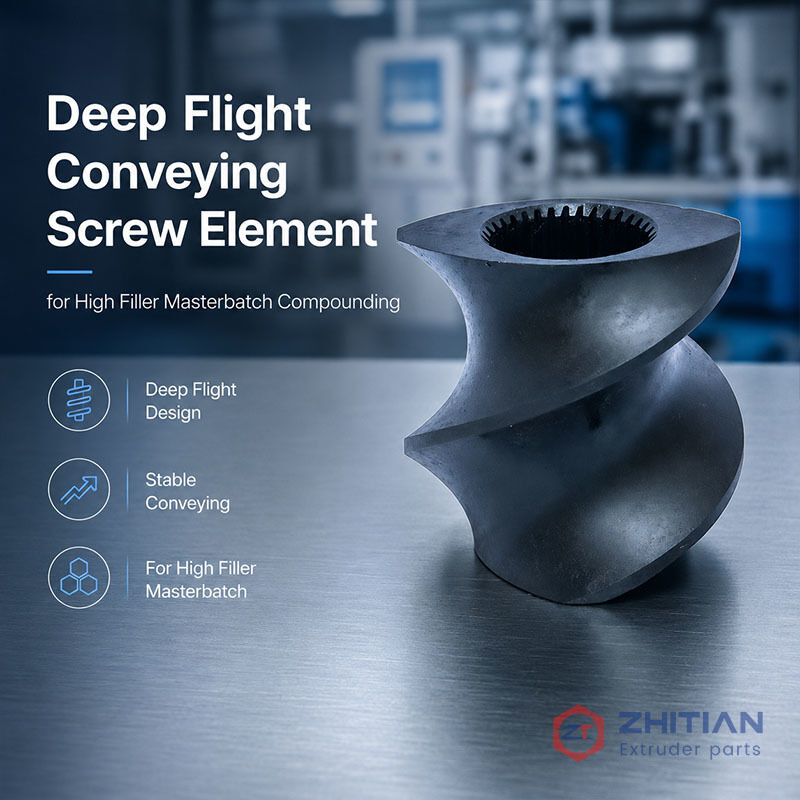
This deep flight screw element is designed for twin screw extrusion processes that require improved intake and conveying of powders, fillers and other low-bulk-density materials.
Compared with a standard conveying element, a deep flight design provides greater free volume in the screw channel. This can help increase material intake capacity and maintain more stable feeding when processing powders or filler-rich formulations.
It helps reduce problems such as:
- Insufficient material intake in the feeding section
- Unstable conveying of low-bulk-density powders
- Fluctuating feed rate during filler addition
- Poor filling in the screw channel
- Feeding inconsistency before downstream mixing sections
- Limited conveying capacity with standard-flight elements
Key Specifications
| Item |
Available Configuration |
| Product type |
Deep flight screw element |
| Main function |
Improve powder and filler feeding |
| Typical applications |
Powder compounding, filler feeding and low-bulk-density materials |
| Element type |
Conveying screw element |
| Channel feature |
Deep flight / increased channel volume |
| Available geometry |
Customized OD, length, pitch and flight form |
| Material options |
Tool steel, wear-resistant steel and selected PM materials |
| Internal connection |
Spline, keyway or customized profile |
| Manufacturing basis |
Drawing, sample or measured dimensions |
| Inspection |
Dimensions, flight geometry, internal spline and surface condition |
| Main purpose |
Increase intake volume and improve feeding stability |
Why Powders and Fillers Are Difficult to Feed
Powders and fillers often behave differently from standard polymer pellets.
Materials with low bulk density or poor flow characteristics may not enter and fill the screw channel as easily as free-flowing pellets.
Typical examples include:
- Calcium carbonate powder
- Talc
- Titanium dioxide
- Carbon black
- Flame-retardant powders
- Fine mineral fillers
- Regrind with light bulk density
- Powder-rich masterbatch ingredients
During feeding, these materials may create problems such as:
- Low intake efficiency
- Feeding fluctuation
- Incomplete channel filling
- Reduced throughput
- Material accumulation near the feed opening
- Instability before downstream kneading or mixing zones
When the standard conveying channel does not provide enough free volume, a deeper flight profile can help the screw capture and move more material forward.
How a Deep Flight Design Improves Feeding
The main advantage of a deep flight screw element is its larger conveying volume.
A deeper flight creates a larger channel space between the screw core and the barrel. This can improve the amount of powder or filler that enters the screw during each rotation.
Potential benefits include:
- Higher intake capacity
- Better conveying of low-bulk-density material
- More stable filling in the screw channel
- Reduced starvation in downstream sections
- Improved continuity before mixing or kneading elements
- Better adaptation to powder-rich formulations
The deep flight design does not solve every feeding problem by itself. Material behavior, feeder performance, screw speed, barrel cooling and overall screw configuration should also be considered.
Suitable Positions for Deep Flight Elements
A deep flight element is usually selected for positions where improved intake or early-stage conveying is needed.
Typical positions include:
- Main feeding zone
- Side-feeding zone
- Powder introduction section
- Filler conveying section
- Early conveying zone before kneading blocks
- Sections where standard conveying elements do not provide enough intake volume
The exact position should be determined according to the screw configuration and process purpose.
In some applications, only one or a few deep flight elements are required. In others, several conveying elements may be combined to create a longer intake and transport section.
Match the Element to the Process Material
The best deep flight design depends on the actual material and process.
Important factors include:
- Powder or filler type
- Bulk density
- Particle size
- Feeding method
- Required throughput
- Screw speed
- Barrel diameter
- Position in the screw configuration
- Downstream screw elements
- Material sensitivity to shear or heat
For example, a material that flows poorly may require more conveying volume, while a filler-rich formulation with higher abrasive load may also require upgraded wear-resistant material.
For this reason, the deep flight geometry and material should be selected together rather than independently.
Material Options for Different Operating Conditions
Standard Tool Steel
For general powder and filler feeding, standard tool-steel solutions may be suitable when abrasive wear is moderate.
Wear-Resistant Steel
Where fillers create greater abrasive load, a wear-resistant material can help maintain flight geometry for a longer period.
Powder Metallurgy Materials
For more demanding applications, selected PM materials can be considered when a different balance of wear resistance, hardness and toughness is required.
Material selection should reflect both feeding function and operating wear conditions.
Custom Replacement for Existing Twin Screw Extruders
Deep flight screw elements can be manufactured according to:
- Original technical drawings
- Existing screw samples
- Measured dimensions
- Screw configuration information
- Process requirements
Customizable features include:
- Outside diameter
- Element length
- Pitch
- Flight depth
- Number of flights
- Internal spline
- Keyway profile
- Material
- Surface treatment
A replacement element must match both the shaft connection and the external working geometry required by the existing screw set.
Manufacturing and Inspection
Inspection can include:
- Outside diameter
- Element length
- Pitch and flight geometry
- Flight depth
- Internal spline dimensions
- Concentricity
- Surface condition
- Material verification
- Heat-treatment condition
- Fit with inspection gauges
Dimensional records can be retained for future repeat orders.
Information Required for Technical Evaluation
Please provide:
- Extruder information
- Screw element drawing or sample
- Processed material
- Powder or filler type
- Bulk density or feeding condition
- Throughput requirement
- Screw speed
- Existing screw element material
- Position of the element in the screw configuration
- Current feeding problem
- Photographs, if available
- Required quantity
Frequently Asked Questions
When should a deep flight screw element be used?
It can be considered when standard conveying elements do not provide enough intake volume or when powder and filler feeding is unstable.
Is a deep flight element suitable for low-bulk-density powders?
Yes. It is commonly used to increase conveying volume and improve intake of powders that do not fill a standard channel easily.
Does a deep flight element increase throughput automatically?
It can help improve intake capacity, but final throughput still depends on feeder performance, screw speed, downstream restrictions and the overall screw configuration.
Can the element also be made in a wear-resistant material?
Yes. If the processed filler is abrasive, a wear-resistant or PM material can be selected according to the operating condition.
Request a Deep Flight Screw Element Review
Send us your screw drawing, material information and current feeding problem.
We can help evaluate:
- Whether a deep flight design is suitable
- Which screw position should use the element
- Whether wear-resistant material is also required
- Which dimensions must be confirmed before replacement
- How the element should match the existing screw configuration
Send Your Screw Element Drawing for Technical Review


 Your message must be between 20-3,000 characters!