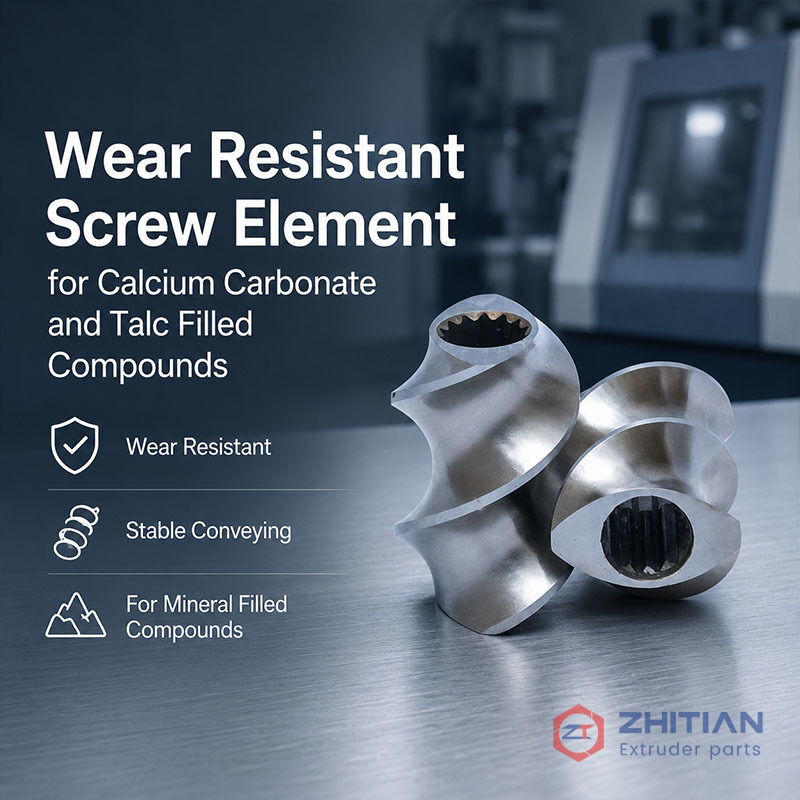
This wear resistant conveying screw element is designed for twin screw compounding applications with high levels of calcium carbonate, talc and other abrasive mineral fillers.
In high-filler processing, mineral particles continuously act on the screw flights and working surface. As the conveying element wears, the screw profile gradually changes, the screw-to-barrel clearance increases and conveying performance becomes less stable.
This screw element is intended to help maintain stable material transport while reducing abrasive wear in conveying sections.
It helps reduce problems such as:
- Rapid wear of screw flights and conveying surfaces
- Loss of conveying efficiency in high-filler formulations
- Increased material backflow caused by worn profiles
- Output fluctuation in continuous production
- Premature replacement of conveying elements
- Reduced pressure stability in downstream sections
Key Specifications
| Item |
Available Configuration |
| Product type |
Wear resistant conveying screw element |
| Main application |
High mineral filler compounding |
| Typical fillers |
Calcium carbonate, talc, mica and mineral powder |
| Element function |
Material conveying and transport |
| Available geometry |
Single-flight, multi-flight or customized conveying profile |
| Material options |
W6Mo5Cr4V2 and selected PM wear-resistant steels |
| Internal connection |
Spline, keyway or customized profile |
| Manufacturing basis |
Drawing, sample or measured dimensions |
| Customization |
OD, length, pitch, flight geometry and internal spline |
| Inspection |
Dimensions, profile, internal connection and surface condition |
| Main purpose |
Reduce wear and maintain stable conveying performance |
Why High Mineral Filler Compounds Wear Conveying Elements
Mineral-filled compounds are widely used to reduce formulation cost or improve stiffness, dimensional stability and other product properties.
However, calcium carbonate, talc and similar fillers also increase abrasive load inside the extruder.
During production, mineral particles repeatedly move between:
- The screw flight surface
- The barrel bore
- Adjacent screw elements
- Material under conveying pressure
This repeated abrasive action gradually wears the working profile of the conveying element.
Wear can become more severe when the process also involves:
- High filler loading
- High screw speed
- Continuous large-volume production
- High throughput
- Long operating cycles
- Restrictive downstream screw sections
As the conveying flights wear, the original conveying geometry is lost and the element becomes less effective at moving material forward.
Maintain Stable Conveying Performance
A conveying element is not only a rotating part. Its geometry directly affects how material is transported through the barrel.
When wear becomes excessive, several process issues may appear:
- Lower conveying efficiency
- Material backflow
- Reduced filling consistency
- Pressure fluctuation
- Instability in downstream mixing or kneading sections
- Lower overall process stability
For this reason, high-filler conveying elements should be selected according to actual wear conditions rather than only the nominal machine size.
Important selection factors include:
- Filler type
- Filler percentage
- Particle size
- Resin system
- Screw speed
- Throughput
- Element position in the screw configuration
- Expected operating time
In many mineral-filled formulations, the conveying section near filler introduction or before high-pressure zones may experience more severe wear than standard low-load sections.
Wear-Resistant Material Options
W6Mo5Cr4V2 Tool Steel
W6Mo5Cr4V2 is a practical wear-resistant material for many mineral-filled compounding applications.
It offers improved wear resistance over more conventional material systems and can be used in many conveying positions exposed to abrasive fillers.
Powder Metallurgy Wear-Resistant Steels
For more demanding high-filler applications, selected powder metallurgy materials can be considered.
These materials can provide a different balance of:
- Wear resistance
- Hardness
- Carbide distribution
- Toughness
- Service life
The most suitable material should be chosen according to the real formulation and operating conditions rather than selecting only by maximum hardness.
Focus Upgraded Materials on High-Wear Positions
Not every screw element in a complete screw shaft experiences the same wear level.
More severe wear often appears around:
- Filler feeding positions
- High-filler conveying sections
- Zones before kneading blocks
- Restrictive or pressure-building sections
- Long-cycle continuous production areas
For this reason, it is not always necessary to upgrade every element in the full screw configuration.
Higher-performance materials can be concentrated in the most heavily worn conveying positions. This helps improve service life while keeping replacement cost under control.
Match the Element to the Existing Screw Configuration
A replacement conveying element must do more than fit the shaft.
The following features should match the existing screw system correctly:
- Outside diameter
- Element length
- Pitch
- Flight geometry
- Number of flights
- Internal spline or keyway
- Connection with adjacent elements
If the external profile or internal connection is incorrect, the element may not work properly in the existing screw arrangement.
For this reason, replacement production should be based on:
- Original drawing
- Existing sample
- Measured dimensions
- Screw configuration information
- Process requirements
Manufacturing and Inspection
Inspection can include:
- Outside diameter
- Element length
- Pitch and profile
- Flight geometry
- Internal spline dimensions
- Concentricity
- Surface condition
- Material verification
- Heat-treatment condition
- Fit with inspection gauges
Dimensional records can be retained for future repeat orders and replacement reference.
Information Required for Material Evaluation
Please provide:
- Extruder information
- Screw element drawing or sample
- Processed polymer
- Calcium carbonate or talc percentage
- Other fillers or additives
- Screw speed
- Approximate throughput
- Existing screw element material
- Current service life
- Photographs of worn elements
- Position of the most severe wear
- Required quantity
This information helps determine whether the main problem is normal abrasive wear, severe profile loss or a broader screw-and-barrel clearance issue.
Frequently Asked Questions
Which material is suitable for high calcium carbonate or talc content?
The correct material depends on filler percentage, particle characteristics, screw speed and service-life target. W6Mo5Cr4V2 or selected PM wear-resistant steels can be considered for severe abrasive service.
Why does a worn conveying element affect output stability?
As the flights wear, the conveying geometry changes and material can backflow more easily through the enlarged screw-to-barrel clearance. This reduces conveying efficiency and can affect downstream process stability.
Do all conveying elements need upgraded wear-resistant material?
No. Higher-performance materials can be concentrated in the conveying positions with the highest abrasive load.
Should the barrel also be checked?
Yes. Screw and barrel wear together determine the actual working clearance. Replacing only the screw element may not fully restore performance if the barrel is also severely worn.
Request a Conveying Element Wear Review
Send us your material formulation, filler percentage, existing screw element material and photographs of the worn element.
We can help evaluate:
- Which conveying positions are wearing most severely
- Whether the current material is suitable
- Which wear-resistant material is more appropriate
- Whether the barrel bore should also be inspected
- Which dimensions must be confirmed before replacement
Send Your Conveying Screw Element Drawing for Technical Review


 Your message must be between 20-3,000 characters!