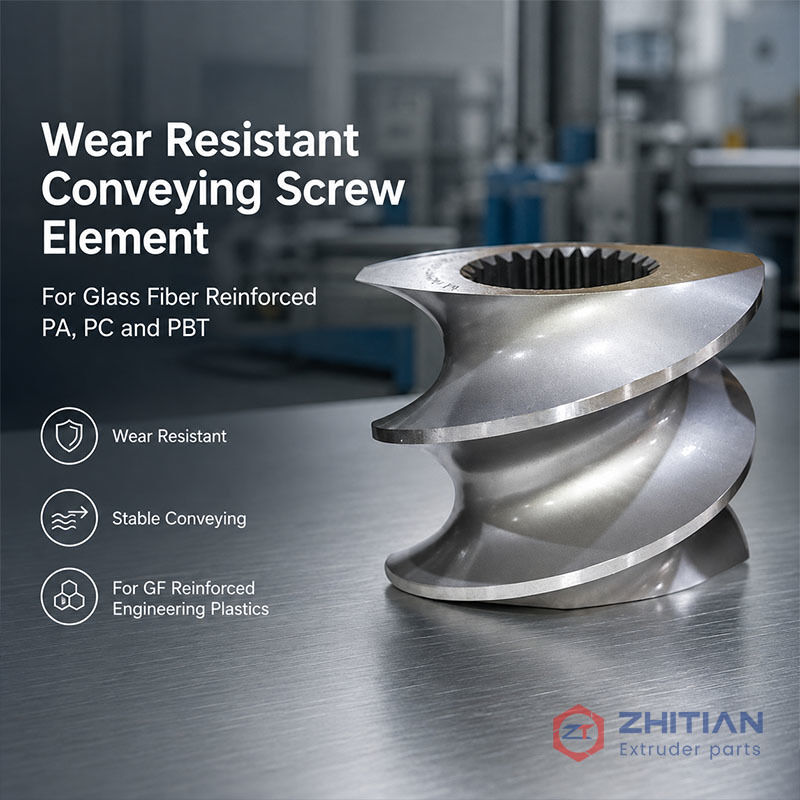
Bimetallic Wear Resistant Kneading Block for Glass Fiber Reinforced Engineering Plastics
This bimetallic kneading block is designed for glass fiber reinforced engineering plastic compounding, including PA, PC, PBT, PET, PPS and PP formulations.
Its bimetallic structure combines a high-hardness wear-resistant alloy layer with a tough steel core. The metallurgically bonded construction improves resistance to abrasive wear while retaining the structural toughness required for high-torque twin screw extrusion.
Key Features
Bimetallic Wear-Resistant Construction
The kneading block features a high-hardness alloy surface layer metallurgically bonded to a tough steel core.
The wear-resistant layer protects the kneading disc edges and working surfaces from continuous abrasion caused by glass fibers, while the core provides the toughness and load-bearing capacity required under demanding compounding conditions.
The surface hardness can reach HRC 60–64, depending on the selected alloy and confirmed heat-treatment specification.
45° Forward-Staggered Kneading Geometry
The five-disc, 45° forward-staggered configuration provides a practical balance between mixing intensity and forward material conveying.
It is suitable for applications requiring improved glass fiber wetting and distribution without generating the excessive back pressure associated with more restrictive kneading configurations.
Disc quantity, disc width and staggering angle can also be customized according to the polymer type, glass fiber content, output requirement and target fiber length.
Improved Glass Fiber Wetting and Distribution
The kneading discs generate controlled shear and elongational flow, helping the polymer melt wet the glass fibers and distribute them more uniformly throughout the matrix.
Improved fiber distribution can help reduce agglomeration and support more consistent mechanical properties in the finished compound.
Balance Between Dispersion and Fiber Length Retention
Glass fiber compounding requires a controlled balance between mixing intensity and fiber length retention.
Excessive shear can improve distribution but may also shorten the fibers and increase melt temperature. The kneading angle, disc width and installation position should therefore be selected according to the required mechanical properties and processing conditions.
High Wear Resistance in Abrasive Applications
The bimetallic wear layer provides improved resistance to profile loss and disc-edge wear compared with conventional nitrided kneading blocks when processing abrasive glass fiber reinforced materials.
Actual service life depends on the glass fiber content, polymer type, screw speed, output, screw configuration and operating conditions.
Precision Manufacturing
Each kneading block is precision machined according to the confirmed drawing, sample or technical dimensions.
Critical dimensions, including the outer diameter, element width, disc angle, bore and spline profile, are inspected to support accurate installation and reliable matching with the existing screw shaft and adjacent elements.
Suitable Materials
- PA6-GF30
- PA66-GF30 and PA66-GF50
- PC-GF20 and PC-GF30
- PBT-GF30 and PBT-GF50
- PET-GF30
- PPS-GF40
- PP-GF20, PP-GF30 and PP-GF40
Long glass fiber compounds require a dedicated low-shear screw configuration and should be evaluated separately according to the required final fiber length.
Typical Applications
- Automotive engineering plastic compounds
- Electrical connector materials
- Power tool housing compounds
- Structural thermoplastic components
- Industrial reinforced plastic compounds
- Glass fiber reinforced pellet production
Customization Options
- Screw diameter
- Disc quantity
- Disc width
- Staggering angle
- Forward, neutral or reverse configuration
- Wear-resistant alloy layer
- Core material
- Surface layer thickness
- Bore and spline dimensions
- Existing screw configuration
- Customer drawing or worn sample
Quality Inspection
Each kneading block is inspected according to the confirmed drawing and technical requirements before shipment. Inspection items may include:
- Outer diameter
- Total element width
- Disc width and staggering angle
- Bore and spline dimensions
- Surface hardness
- Layer thickness
- Surface defects
- Dimensional fit with adjacent elements
Depending on the product specification, inspection methods may include dimensional measurement, hardness testing, dye penetrant inspection and metallographic verification of the bimetallic bonding structure.
Material certificates and dimensional inspection records can be provided upon request.


 Your message must be between 20-3,000 characters!